This is the Nova Scotia chapter of Bambi's guide to starting a non-emergency medical transportation business, and it opens with the same warning every Canadian chapter does. There is no Medicaid here, and there is no transportation broker.
Nova Scotia states it directly: ground ambulance fees are a non-insured service under the Canada Health Act, and the MSI regulations exclude mileage and travel. Provincial health insurance does not cover it. Getting a patient to a medical appointment in a wheelchair van or a stretcher van is not an insured service, and no province has ever tendered a transportation brokerage contract. Modivcare, MTM and Verida have no Canadian operations. Nova Scotia is also the province where the government built its own non-emergency tier rather than buying one from a private market, which changes the competitive picture completely.
So the question is not "how do I credential with the broker." It is "who actually pays, and how do I get in front of them." That is what this guide covers.
Part 1: Who Actually Pays
Part 2: Licensing and Regulation
Part 3: Registering the Business
Part 4: Vehicles, Drivers and Insurance
Part 5: Who Buys, and the Market
Part 6: Technology
This is the Nova Scotia chapter of Bambi's complete guide to starting a NEMT business. For the national picture, start with our guides to the NIHB Medical Transportation Benefit and winning health authority transport contracts.
In This Guide
- Part 1: Who Actually Pays
- Part 2: Licensing and Regulation
- Part 3: Registering the Business
- Part 4: Vehicles, Drivers and Insurance
- Part 5: Who Buys, and the Market
- Part 6: Technology
Part 1: Who Actually Pays
- EHS competes with you. Nova Scotia runs Patient Transfer Units staffed by one driver and one paramedic, plus roughly 180 non-paramedic Transport Operators. The province looked at the non-emergency gap and filled it in-house. Understand that before you model market share.
- The regulated fee is a price ceiling, not your revenue. Nova Scotia's Ambulance Fee Regulations set $108.95 for transporting a mobility-challenged individual to a physician, dentist or physiotherapy office. That is what a patient pays EHS. It is not a rate payable to you. It is the number you have to compete against, and it is low.
- Other ambulance fees show the wider structure: $146.55 for a resident, $54.50 for a long-term care resident, $732.95 for a non-Nova Scotian Canadian, and inter-facility at $0. Note that a long-term care to long-term care move is billed as a private call at $732.95, which is a genuine private-market opening.
- Income assistance can pay you directly. Nova Scotia's ESIA policy allows direct payments to third parties including vendors and suppliers. But it will not fund non-emergency ambulance, so structure your service accordingly.
- NIHB Atlantic totalled $18.3M across all four Atlantic provinces in FY2023-24, and the majority is delivered through contribution agreements rather than ISC operating funds. That means your counterparty is often a First Nation or a regional health authority, not a federal office.
Part 2: Licensing and Regulation
Nova Scotia is not licence-free, despite what you may read.
There is no health-side patient transfer licence, because EHS operates as a contract monopoly under the Emergency Health Services Act. But Nova Scotia still economically and safety-licenses passenger motor carriers. A recurring-schedule non-emergency transport van will very likely need a commercial vehicle licence at $257.65 per vehicle per year from the Nova Scotia Regulatory and Appeals Board, the renamed NSUARB.
We flag this specifically because several widely-shared guides describe Nova Scotia as unregulated. Confirm your status with the Board before you operate.
Part 3: Registering the Business
- Incorporation: $200 for a limited company. Annual registration is $118.35, fixed in statute and payable in your anniversary month rather than by calendar year.
- Sole proprietorship or business name declaration: $68.55.
- Name reservation: $60.52 for an Atlantic NUANS, $75.58 federal, or $15.12 if you supply your own NUANS under 90 days old.
- A recognized agent resident in Nova Scotia is required. There is no director residency requirement.
- HST is 14%, not 15%. The provincial portion dropped from 10% to 9% on April 1, 2025. Older guides have this wrong.
- The taxi trap is the most important tax fact on this page. The Excise Tax Act requires every small supplier carrying on a taxi business to register for GST/HST, and the $30,000 threshold does not apply. The definition catches fares regulated by law or transport within a municipality arranged through an electronic platform. If you dispatch through an app, you must register from day one regardless of revenue.
- WCB Nova Scotia has a three-worker threshold, and a working officer or director counts toward the three. But note the carve-out: the operation of taxicabs is excluded from the Act entirely, regardless of headcount. Which side of that line you fall on matters.
Part 4: Vehicles, Drivers and Insurance
- "For hire" is the controlling variable, not seat count. That is the framing to hold onto in Nova Scotia.
- Confirm your commercial vehicle licence status with the Regulatory and Appeals Board before you buy vehicles.
- Insurance: confirm current for-hire minimums directly with the Board and your broker. We could not verify a single authoritative current figure, and we would rather say so than publish a number you might rely on.
Part 5: Who Buys, and the Market
How to get in. Nova Scotia Health is the single provincial health authority and the main institutional counterparty. Because EHS already runs an in-house non-emergency tier, the realistic private openings are the ones EHS does not serve well: long-term care to long-term care moves billed as private calls at $732.95, discharge transport, dialysis standing orders, and private pay for an older population that is not being served by a $108.95 regulated fee.
Market size. Population about 1.09 million with a 65-plus share of 22.6%, the third oldest province in Canada, and 41.1% rural. Nova Scotia's demand is squarely age-driven. The constraint is not demand, it is that the province has already built a public answer to part of it.
Part 6: Technology
Get started with Bambi
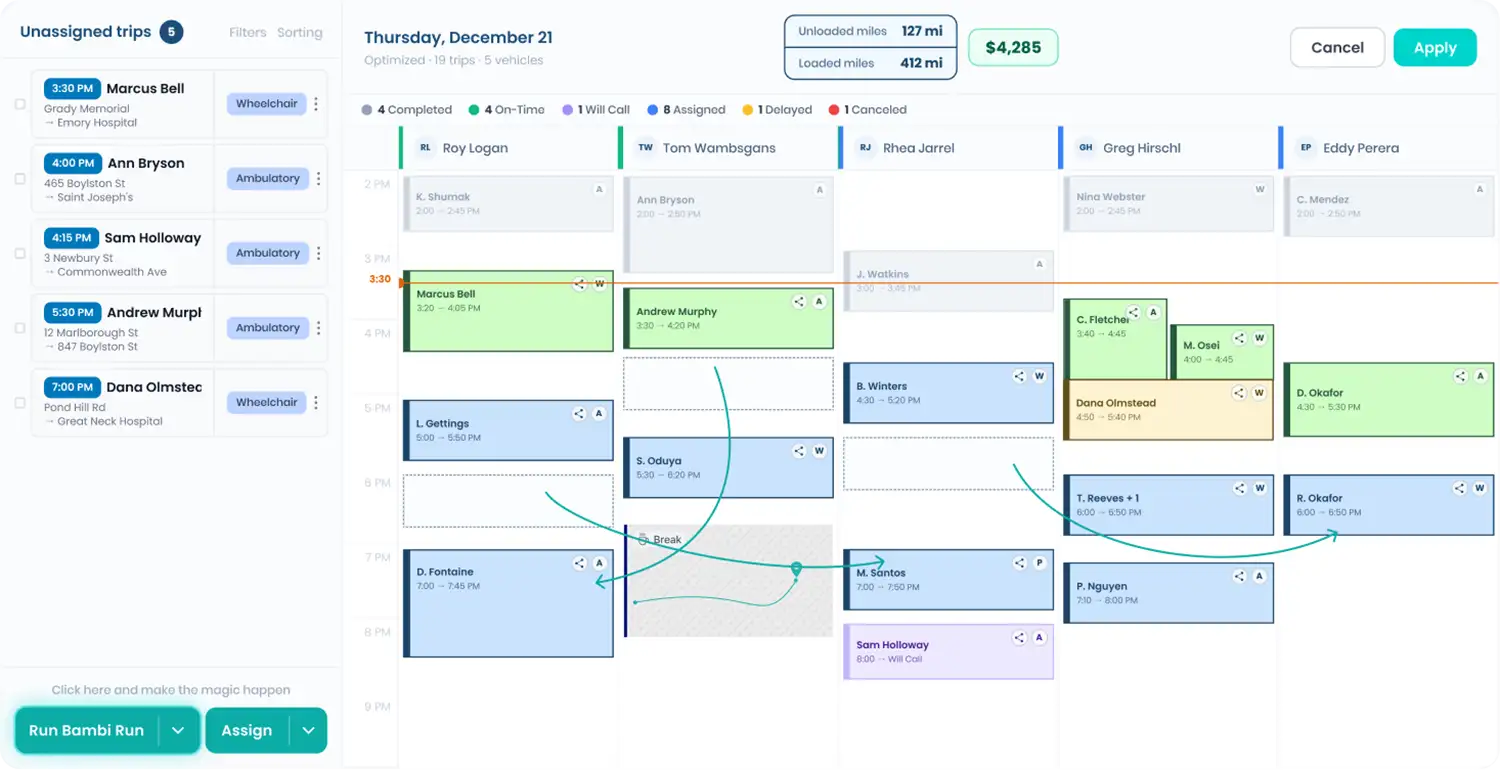
Our aiNEMT software handles scheduling, dispatching, care coordination and real-time tracking. In a market with no broker feeding you trips, the admin all lands on you, which is exactly where software earns its keep. Get in touch for a demo.