
This is the Saskatchewan chapter of Bambi's guide to starting a non-emergency medical transportation business, and it opens with the same warning every Canadian chapter does. There is no Medicaid here, and there is no transportation broker.
The Saskatchewan Health Authority is blunt: you are billed for transfers for appointments. Provincial health insurance does not cover it. Getting a patient to a medical appointment in a wheelchair van or a stretcher van is not an insured service, and no province has ever tendered a transportation brokerage contract. Modivcare, MTM and Verida have no Canadian operations. Saskatchewan has one genuine exception and, for a ground operator, the best NIHB opportunity in the country.
So the question is not "how do I credential with the broker." It is "who actually pays, and how do I get in front of them." That is what this guide covers.
Part 1: Who Actually Pays
Part 2: Licensing and Regulation
Part 3: Registering the Business
Part 4: Vehicles, Drivers and Insurance
Part 5: Who Buys, and the Market
Part 6: Technology
This is the Saskatchewan chapter of Bambi's complete guide to starting a NEMT business. For the national picture, start with our guides to the NIHB Medical Transportation Benefit and winning health authority transport contracts.
In This Guide
- Part 1: Who Actually Pays
- Part 2: Licensing and Regulation
- Part 3: Registering the Business
- Part 4: Vehicles, Drivers and Insurance
- Part 5: Who Buys, and the Market
- Part 6: Technology
Part 1: Who Actually Pays
- The Northern Medical Transportation Program is an actual insured service administered by the Ministry of Health, covering non-emergency medical taxi for social assistance clients. This is a real, funded, ongoing programme, and carriers are assigned a four-digit payee code for invoicing. It is the exception to the national no-coverage rule.
- RFP700021326 established a province-wide qualified vendor list for non-medical transportation across standardized service types. Getting on a qualified vendor list is the practical entry point.
- NIHB in Saskatchewan is where ground operators should look. Saskatchewan received $115.9M in FY2023-24. Unlike Manitoba, the modal split favours you: $35.8M land ambulance plus $17.6M land and water equals $53.4M of ground spend, against only $14.4M of air. Saskatchewan is the ground-NEMT opportunity in the NIHB system.
- Ambulance charges create the private market. $245 to $325 base plus $2.30/km. Note two traps in the provincial structure: step-up transfers to a higher level of care are billed to the patient, and the seniors programme that caps costs at $135 expressly excludes non-emergency medical transportation.
- Social services pays the client, not you. Saskatchewan's Income Support regulations restrict third-party payment to shelter, utilities and arrears. The travel benefit is not on that list, so on the social-assistance side money reaches the client. The Health-administered northern programme is the opposite and pays providers directly. Know which one you are dealing with.
Part 2: Licensing and Regulation
Everything is an ambulance service, and the crew standard is the strictest in Canada.
The Ambulance Act has no tiers. Non-emergency patient transport is captured as an ambulance service, and the crew must include a physician, a registered nurse, or a member of the College of Paramedics. There is no attendant-level option.
Be realistic about what that means. A stretcher or ambulance-classified operation in Saskatchewan carries a clinical wage on every trip. For most new entrants the viable business is seated and wheelchair transport that does not attract the Act, which is exactly what the Northern Medical Transportation Program and the qualified vendor list are buying.
Settle your vehicle registration class first, because it is the hinge. The regulations require any vehicle used to transport passengers for compensation to be registered as Class PC, PB or PT. Class PC covers vehicles used to transport individuals with a disability and those travelling with them, and the usual ten-seat minimum expressly does not apply to that use. So a four-passenger wheelchair minivan can be PC-registered, at $48 flat.
Then the driver class follows from it, and this is the decisive rule. Class 4 covers PB and PC vehicles carrying up to 24 passengers for hire when not used exclusively to transport passengers with a disability and their attendants. Class 5 covers the same vehicle when it is used exclusively for passengers with a disability and their attendants, capped at 12 passengers. Structure your service as exclusively disability transport and your drivers need only a Class 5.
Part 3: Registering the Business
- The registry moved to saskregistries.ca. Old ISC fee URLs return 404 and Saskatchewan eXpress is retired. Do not follow stale instructions.
- Fees effective April 15, 2026: incorporation $255, business name registration $65, name reservation $50, NUANS $60, annual return $60 on time or $110 late.
- PST is 6% and passenger transportation is not on the taxable services list. You still need a PST number, because vehicle repair and installation are taxable.
- WCB Saskatchewan is mandatory. Payroll statement due February 28. Note a 2025 change: directors of corporations, including those receiving T4 wages, are no longer workers.
- 2026 rates per $100 of payroll: ambulance service $1.91, taxi and rideshare $1.48, commercial bus $2.82. The classification you receive matters.
Part 4: Vehicles, Drivers and Insurance
- Vehicle registration: Class PC at $48, per the rule above.
- Driver licence: Class 5 if you serve disability passengers exclusively and stay at or under 12 passengers. Class 4 otherwise.
- Insurance: SGI is the public insurer. It covers transportation statutorily and can direct-pay on a claim, but there is no self-serve vendor credentialing.
Part 5: Who Buys, and the Market
How to get in. Two concrete steps. Get onto the province-wide qualified vendor list, and contact the Northern Medical Transportation Program about a payee code. Both are documented processes with a defined end state, which is more than most provinces offer.
One correction to the numbers you may see elsewhere. A rate of $0.82 per kilometre plus $22 per hour of wait time circulates widely as the Saskatchewan medical taxi rate. We traced it to a 2008 news release. Do not treat it as current. Ask the programme for today's schedule.
Market size. Population about 1.27 million with a 65-plus share of 17.8%. Like Manitoba, the demand driver is distance and Indigenous population rather than age: 17.0% of residents report Indigenous identity, and 31.7% live rurally. Saskatchewan's combination of a real insured northern programme, a qualified vendor list, ground-weighted NIHB spend and a Class 5 pathway makes it one of the more accessible markets in Canada despite the strict ambulance regime.
Part 6: Technology
Get started with Bambi
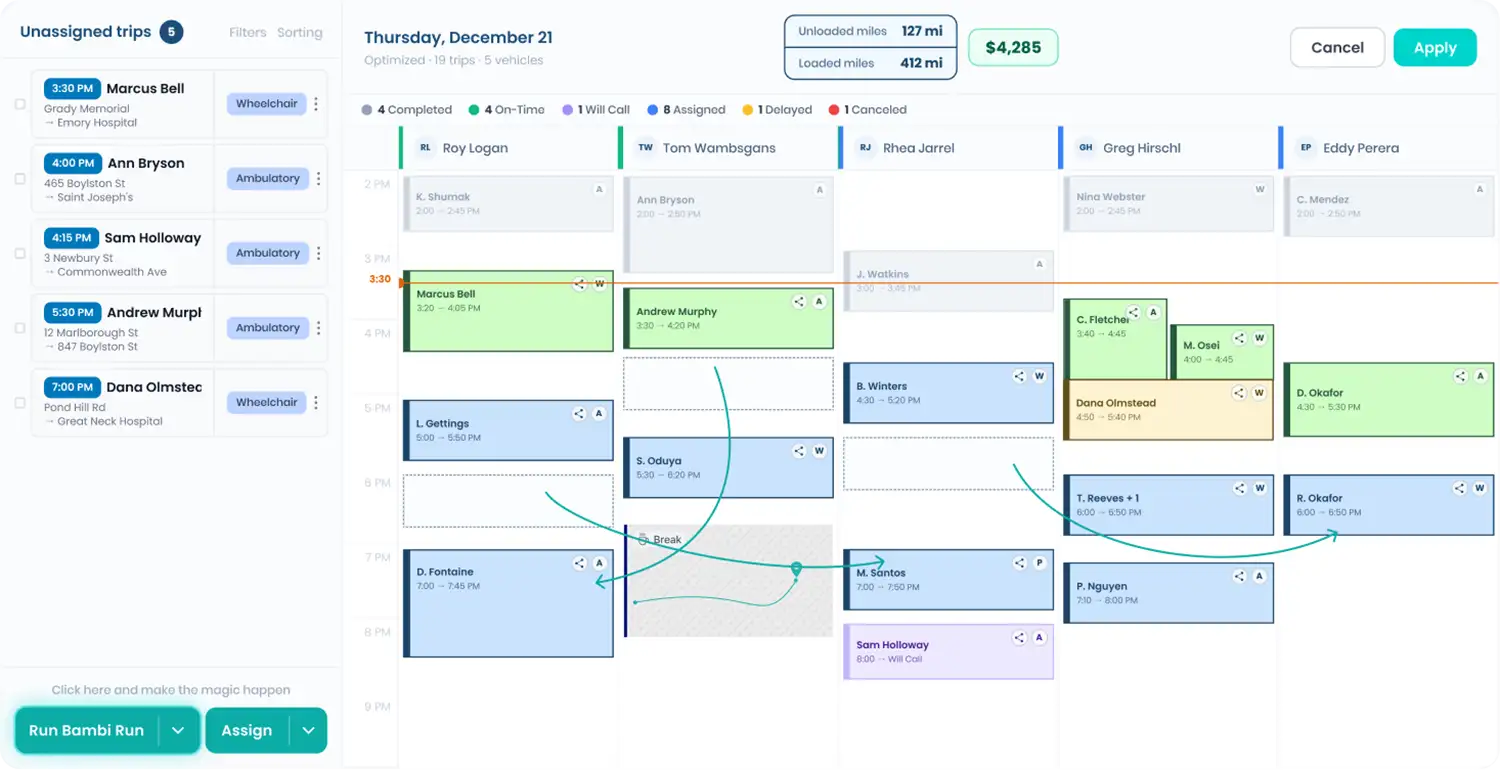
Our aiNEMT software handles scheduling, dispatching, care coordination and real-time tracking. In a market with no broker feeding you trips, the admin all lands on you, which is exactly where software earns its keep. Get in touch for a demo.