
By Nick Hoffmeyer, Head of Marketing at Bambi · September 28, 2026 · 6 min read
"Where's my ride?" is one of the most common calls a non-emergency medical transportation (NEMT) dispatcher gets, and it's rarely about the trip being late. It's about the rider, front-desk staff, or a family member having no way to see what dispatch already knows. Real-time GPS tracking, live ETAs, and automatic notifications close that gap, and closing it moves on-time performance.
Why Does "Where's My Ride?" Keep Coming Up?
It keeps coming up because most riders and facilities have zero visibility into a trip once it's booked. A dialysis patient waiting on a discharge ride, a nursing home coordinator juggling a dozen pickups, a daughter checking on her father's ride to a specialist appointment... none of them can see the vehicle. All they can do is call.
That call lands on dispatch, who now has to stop scheduling the next trip to answer a question they could see the answer to in three seconds on their own screen. Multiply that by every rider on today's board and you get a dispatcher spending a real chunk of the day on status updates instead of running the fleet. It's not a training problem or a communication problem in the usual sense. It's a visibility problem, and it has a straightforward fix: give riders and facilities the same information dispatch already has.
Why Rider Visibility and On-Time Performance Matter
Rider visibility and on-time performance matter because unreliable transportation directly threatens whether patients get to appointments at all, and that's not a minor operational detail, it's a documented access-to-care problem. About 5.8 million Americans delayed medical care in a single year because they lacked transportation, according to a 2020 study in the American Journal of Public Health (Wolfe, McDonald & Holmes).
Timeliness and reliability are the most-cited NEMT complaints in beneficiary research, not cost or availability. A 2021 review from the Medicaid and CHIP Payment and Access Commission documented beneficiaries missing repeated dialysis appointments because drivers arrived late, waiting up to three hours for return trips, and in at least one case being hospitalized after missing treatment during a stretch of unreliable rides (MACPAC, "Understanding the Value of the Medicaid Non-Emergency Medical Transportation Benefit", 2021).
For a fleet, the business case sits right behind the human one. Facilities that can see a live ETA stop calling dispatch to ask, front-desk staff can tell a patient "your ride's eight minutes out" instead of "we're not sure," and brokers and Medicaid managed care plans increasingly track on-time performance as a contract metric. A provider that can prove reliability wins more referral volume and keeps the broker relationships that keep the fleet full.
How Real-Time NEMT Ride Tracking Actually Works
Real-time NEMT ride tracking works by pulling a driver's live GPS position, recalculating the arrival estimate as conditions change, and pushing that information out to riders and facilities automatically instead of making them ask.
Live GPS location
Every vehicle on the road reports its position continuously, so dispatch sees exactly where a driver is, not where the schedule assumed they'd be by now. Riders and caregivers get that same visibility through a link texted to their phone, the Public Trip Portal, which shows a live map of the vehicle for the whole trip, from driver en route through trip completion. No app download is required, and the link expires once the trip wraps up.
Dynamic ETA recalculation
A good system doesn't just show a static pickup time from this morning's schedule. It recalculates the estimated time of arrival as traffic, an earlier stop running long, or an added will-call request shifts a driver's route, so the number a rider sees reflects the vehicle's actual position.
Automatic rider and facility notifications
Instead of a rider calling dispatch, the system tells them: a text alert when the driver is en route, with a tracking link included, an update if the ETA shifts, and a heads-up when the vehicle is close. Bambi's SMS notifications include the Public Trip Portal link, so caregivers can follow the vehicle without calling in.
Driver-side confirmation
None of this works if the driver isn't the source of the data. A mobile driver app that shares location, confirms pickups and drop-offs, and flags delays in real time is what feeds everything upstream: dispatch's live board, the facility's view, and the rider's notification.
Without Real-Time Visibility vs. With It
- Rider/facility question: Without real-time visibility: Calls dispatch to ask "where's my ride?"; With real-time tracking + notifications: Checks a live ETA or gets a notification automatically
- Dispatcher's day: Without real-time visibility: Interrupted repeatedly for status checks; With real-time tracking + notifications: Fewer status calls, more time on scheduling
- Late or delayed trips: Without real-time visibility: Discovered when the rider calls, or not at all; With real-time tracking + notifications: Spotted as the ETA drifts, before it cascades into a missed pickup
- Facility relationship: Without real-time visibility: Frustration builds with every unanswered call; With real-time tracking + notifications: Facility sees reliability directly, without calling
- No-show risk: Without real-time visibility: Rider isn't ready because they didn't know timing; With real-time tracking + notifications: Rider gets a heads-up and is ready when the vehicle arrives
What to Look for in a Real-Time NEMT Tracking Solution
- Live, GPS-based vehicle tracking visible to dispatch, not a manual "check-in" system that depends on drivers remembering to call.
- ETAs that recalculate automatically as routes shift, not a static time pulled from the morning schedule.
- Rider notifications (text or app) for en-route status and meaningful ETA changes, without dispatch having to send them manually.
- Facility-level visibility, so a coordinator managing multiple riders can see status without a phone call for each one.
- A mobile driver app that feeds the tracking data in the first place, confirms pickups and drop-offs, and flags delays as they happen.
- On-time performance reporting, so a provider can show a broker or facility real numbers instead of an anecdote.
How Bambi Answers "Where's My Ride?"
Bambi's Fleet HQ gives dispatchers a live, GPS-based view of every vehicle on the road. Riders and facilities get that same visibility without calling in: an SMS link to the Public Trip Portal shows a live map of the vehicle for the whole trip, from driver en route to trip completion, no app download needed, and the link expires once the trip is done.
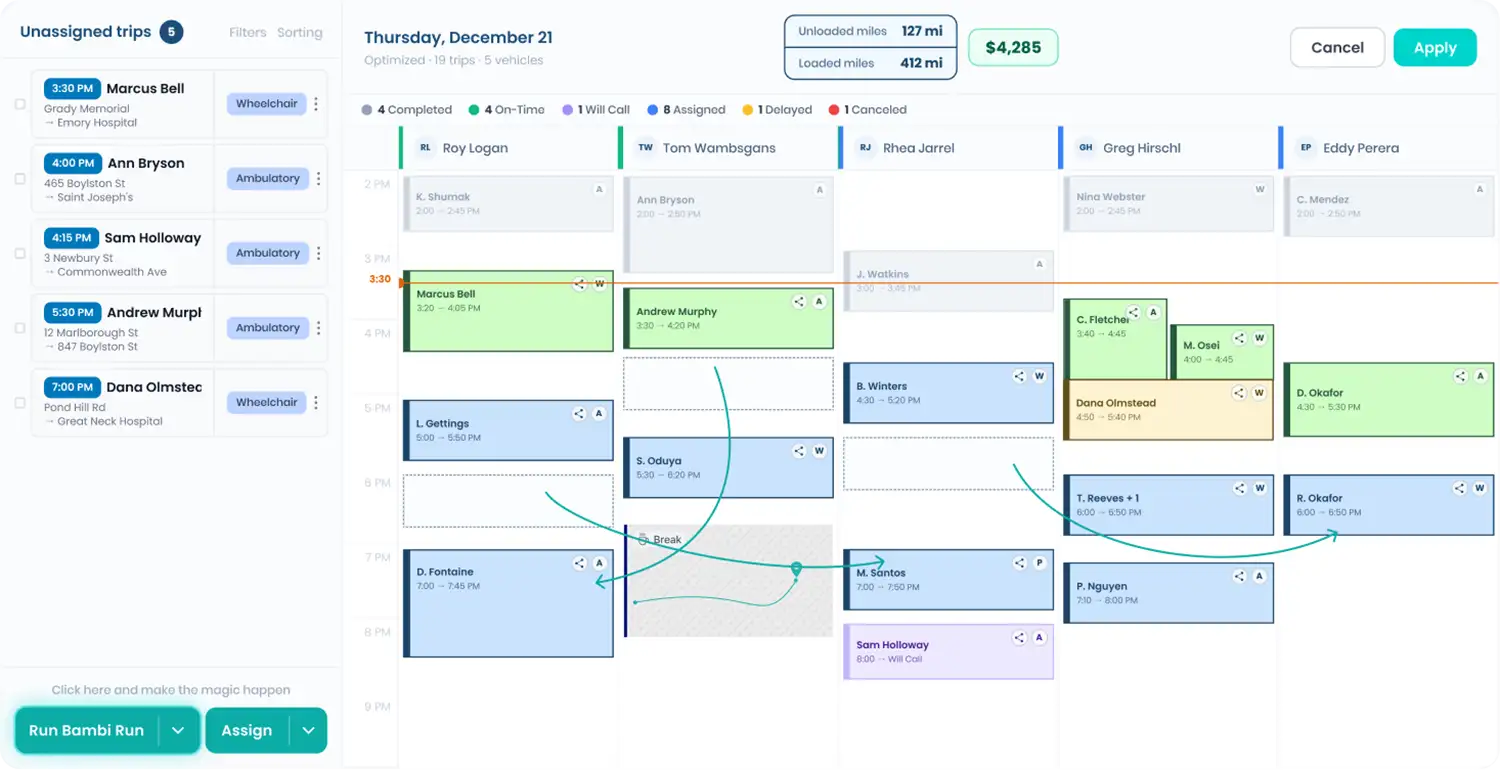
None of that works without the driver side. The Driver App is what feeds Fleet HQ its real-time location and pickup/drop-off confirmations, so the ETA a rider sees reflects where the vehicle actually is, not where the schedule assumed it would be. When the day changes, dispatchers can re-run Run Bambi Run to rebuild assignments in one click instead of reshuffling trips by hand. See pricing or book a demo to see it on your own trips.
FAQ
What does "where's my ride" usually mean for a rider or facility? It means they can't see the vehicle's real location or a current arrival estimate, so they're calling dispatch to get information that live tracking could show them directly.
How does real-time NEMT ride tracking work? A driver's GPS location feeds a live dispatch view, the estimated time of arrival recalculates as conditions change, and riders or facilities get automatic notifications instead of having to call and ask.
Does rider visibility actually reduce no-shows? It can, because riders who get a heads-up on timing are more likely to be ready when the vehicle arrives.
What is on-time performance in NEMT, and why do brokers track it? On-time performance measures how often a provider's vehicles arrive within an agreed pickup window. Brokers and Medicaid managed care plans track it because late or missed pickups threaten member access to care, and it factors into which providers keep getting referrals. The exact window varies by broker and payer contract.
Do riders need to download an app to get ride notifications? No, not with Bambi. Notifications go out by text, including a link to the Public Trip Portal with a live map of the vehicle for the whole trip. No app download is required, and the link expires once the trip is complete.
What should a facility look for from an NEMT provider on visibility? A live view of pickup status for their patients, without having to call for each one, and a track record of on-time performance the provider can actually show, not just describe.
About the author: Nick Hoffmeyer is Head of Marketing at Bambi, the AI-powered dispatch and scheduling platform for non-emergency medical transportation (NEMT) providers. He leads Bambi's growth, SEO, and content strategy and works with NEMT owner-operators every day on the systems that help fleets run more trips with less stress. Connect with Nick on LinkedIn.