
By Nick Hoffmeyer, Head of Marketing at Bambi · September 28, 2026 · 9 min read
Reviewed by Howard F. Berkowitz, a non-emergency medical transportation and paratransit expert with 30+ years in the industry (H&S Consulting).
A great NEMT driver shows up on time, treats riders with patience, and keeps a clean file. Finding one means recruiting past the usual job boards; keeping one means paying fairly, training well, and giving them a schedule that doesn't waste their day in the car empty. Most driver turnover traces back to one of those three.
What Does an NEMT Driver Do?
An NEMT driver picks up patients for non-emergency medical transportation (NEMT), meaning dialysis, chemotherapy, physical therapy, and routine doctor visits, and gets them there and home safely, often with a wheelchair, walker, or stretcher involved. A typical shift looks like four to eight trips: check the vehicle, confirm the day's manifest, drive to the pickup, help the rider in and out, document mileage and time at each stop, and stay in touch with dispatch when a pickup runs late or a rider no-shows.
The job is part driver, part caregiver. Riders are often older, managing a chronic condition, or anxious about the appointment itself, so patience and communication matter as much as a clean driving record. Dispatchers lean on drivers to flag problems in real time (a locked gate, a rider not ready, a facility running behind) because a five-minute delay on trip one cascades through the whole day's manifest.
Where to Find NEMT Drivers to Hire
Post the job where NEMT-curious drivers already are: rideshare and delivery driver groups (many are looking for steadier, scheduled work), local senior centers and community colleges with CDL or healthcare-adjacent programs, veteran and military transition boards, and driving schools that train passenger-endorsement or medical transport drivers. Facebook driver groups and Indeed still convert, but referral bonuses from current drivers tend to bring in people who already understand the pace of the job.
Don't overlook people leaving home health aide, EMT-basic, or school bus roles. They already have the temperament for working with patients and often just need NEMT-specific onboarding, not a new career.
- Driver referral bonus: Typical cost: Low (bonus only, paid on retention); Best for: Fast hires who fit the culture
- Local job boards / Indeed: Typical cost: Low-medium; Best for: High volume, general applicant pool
- Driving schools / CDL programs: Typical cost: Medium; Best for: Newly licensed, trainable drivers
- Community college healthcare programs: Typical cost: Medium; Best for: Candidates with patient-care instincts
- Facebook rideshare/delivery driver groups: Typical cost: Low; Best for: Drivers wanting steadier scheduled hours
NEMT Driver Requirements and Qualifications
Every NEMT driver needs, at minimum, a valid driver's license appropriate to the vehicle (federal rules require a commercial driver's license only for vehicles designed to carry 16 or more people including the driver, so most sedans and wheelchair vans don't need one; check your state for anything stricter), a clean motor vehicle record, a passed background check, and a drug screen. Many states and brokers also require a DOT physical and passenger-assistance or wheelchair-securement training before a driver takes their first trip.
Every one of those documents, the application, MVR, medical certification, road test, and drug testing records, belongs in the driver's file before they're ever behind the wheel. Skipping that step is the single most common thing an auditor or an insurance carrier catches first.
NEMT Driver Training
Good onboarding covers more than paperwork. New drivers need passenger assistance techniques (safely transferring a rider from wheelchair to seat), wheelchair and stretcher securement, defensive driving refreshers, basic HIPAA awareness (riders' medical details are not small talk), and whatever certification the brokers you work with require. Our full breakdown of what to include, state by state, is in NEMT driver training resources.
Training doesn't stop after week one. Fleets that run short refreshers twice a year, on securement, de-escalation, and dispatch communication, tend to see fewer complaints and fewer preventable incidents than fleets that train once and move on.
NEMT Driver Pay and Incentive Structures
Pay usually runs hourly, per-trip, or a blend of the two, with mileage or fuel stipends layered on top. Median pay for the closest published federal wage category, ambulance drivers and attendants (excluding EMTs), gives a rough benchmark (BLS occupation code 53-3011, published by state and metro area), but NEMT-specific pay varies by market and vehicle type. Incentive structures that work well in practice: a small bonus for zero no-shows in a pay period, a quality bonus tied to rider feedback, and a retention bonus paid at 90 and 180 days, when most new-driver turnover happens. For more ideas, see our checklist for designing driver incentive programs.
Reducing NEMT Driver Turnover
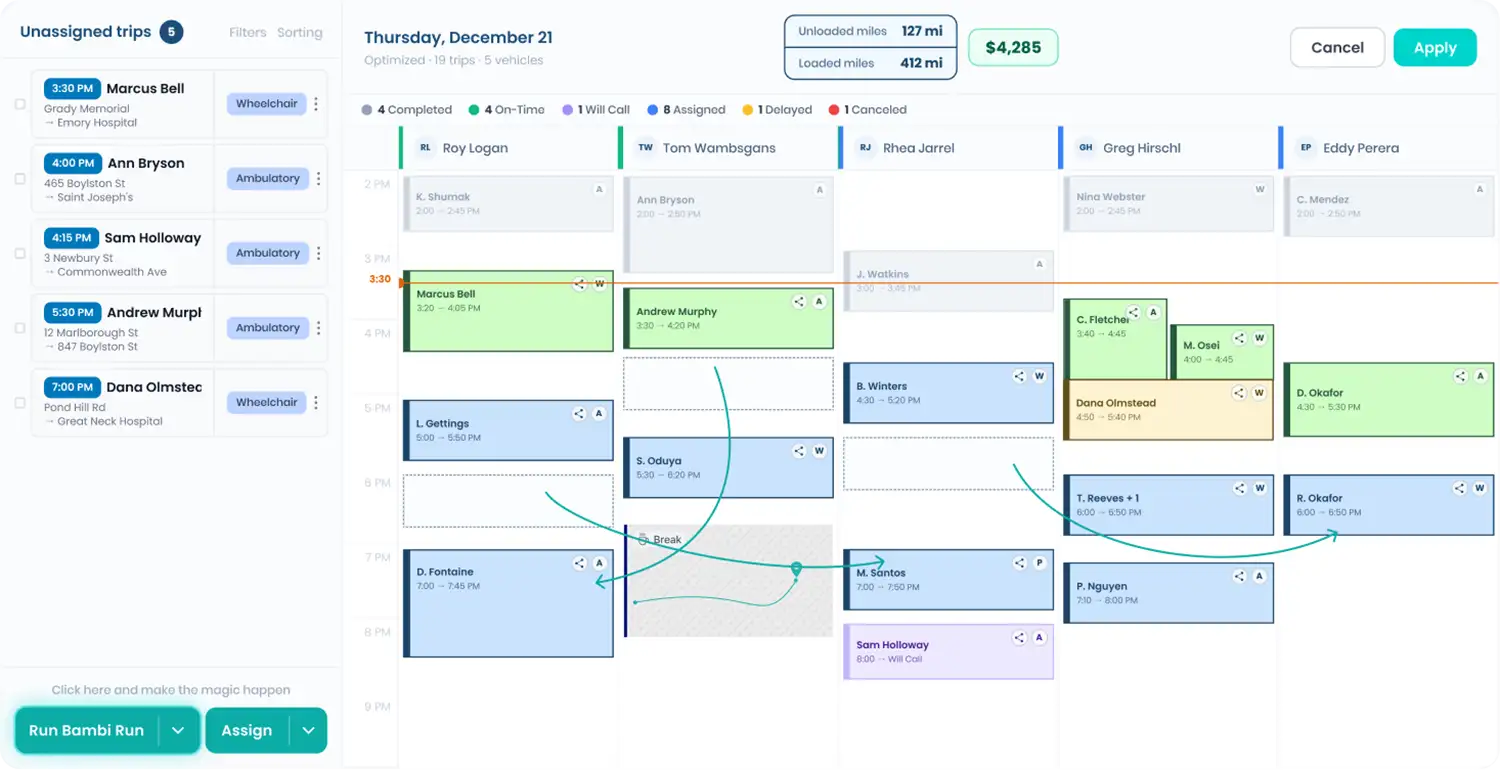
Turnover in NEMT rarely comes down to the driving itself. It comes down to deadhead miles (driving empty between trips), chaotic last-minute schedule changes, and constant back-and-forth with dispatch over the phone. Fix the route quality and the schedule, and a lot of the frustration that drives good drivers out the door goes away with it.
This is where software actually changes retention, not just efficiency. Bambi's Driver App gives every driver a clear manifest, the details for every pickup, and a direct messaging line to dispatch, so a driver isn't guessing about the next stop or waiting on hold to report a delay. Fewer surprises and less dead time between trips means a driver's day feels manageable instead of chaotic, and a driver who isn't burned out by 3pm is a driver who's still there next quarter.
Quick onboarding checklist for a new NEMT driver
- Complete application, license check, and background screen
- Pass drug test and DOT physical (where required)
- Assemble the driver qualification file
- Complete passenger assistance and securement training
- Ride along on 2-3 live trips with an experienced driver
- Set up the Driver App and confirm dispatch communication works
- First solo shift with a check-in call at midday
FAQ
What does an NEMT driver do? An NEMT driver transports patients to and from non-emergency medical appointments like dialysis, therapy, and routine checkups, handling pickups, wheelchair or stretcher assistance, and communication with dispatch throughout the shift.
What qualifications do you need to become an NEMT driver? A valid driver's license, a clean motor vehicle record, a passed background check and drug screen, and often a DOT physical and passenger-assistance training, all documented in a driver qualification file.
Do NEMT drivers need a CDL? Most sedans and wheelchair vans don't require one. Federally, a CDL is only required for vehicles designed to carry 16 or more people including the driver. Check your state DMV for anything stricter.
How much do NEMT drivers get paid? Pay varies by market, vehicle type, and pay structure (hourly, per-trip, or mileage-based), often with bonuses for attendance, quality, or retention layered on top.
Where can I find NEMT drivers to hire? Driver referrals, local job boards, driving schools, community college healthcare programs, and rideshare or delivery driver groups looking for steadier scheduled work.
Why is NEMT driver turnover so high? It's usually deadhead miles, unpredictable schedules, and friction with dispatch, not the driving itself. Better routing and clearer communication tools address the root cause instead of just the symptom.
Ready to give your drivers a day that actually runs on schedule?
Bambi's Driver App turns a chaotic manifest into a clear one, so drivers spend less time waiting on dispatch and more time on the road getting paid. Fewer headaches for your drivers means fewer good ones walking out the door. See Bambi's pricing, starting at $69/month per vehicle, flat, no contracts.
Nick Hoffmeyer is Head of Marketing at Bambi, the AI-powered dispatch and scheduling platform for non-emergency medical transportation (NEMT) providers. He works with NEMT owner-operators every day on growth, SEO, and the operational systems that help fleets run more trips with less stress. More from Nick: LinkedIn