

The Transportation Alliance Foundation just dropped a landmark study on how outdated regulations are hurting for-hire transportation providers — and NEMT operators should be paying close attention.
Published: February 2026 | Category: Industry News & Regulation | Read time: ~8 min
If you run a non-emergency medical transportation company, you already know the regulatory landscape feels like it was designed for a different era. You’re juggling Medicaid contracts, commercial insurance mandates, vehicle inspections, and licensing requirements that seem to multiply every time you cross a county line.
Now there’s a major new report that puts hard data and real-world case studies behind what many of you have been saying for years: the rules aren’t fair, and they’re holding the industry back.
In January 2026, The Transportation Alliance Foundation (TTAF) and the University Transportation Research Center (UTRC) at the City College of New York published “Mobilizing for Fair Regulation & Competition with Transportation Network Companies (TNCs)” — a comprehensive study examining how outdated regulations create an uneven playing field between traditional for-hire vehicle operators (taxis, limousines, and yes, NEMT providers) and app-based platforms like Uber and Lyft.
The report was authored by Matthew W. Daus, Esq., a nationally recognized transportation law expert and former NYC Taxi & Limousine Commissioner. While the study primarily targets taxi and limousine policy, the implications for NEMT operators are significant. Let’s break down what it means for your business.
The report’s central finding is straightforward: traditional transportation providers — taxis, limousines, and the fleets that many NEMT companies operate — are regulated under a patchwork of strict local rules, while TNCs like Uber and Lyft operate under lighter, statewide frameworks. According to the study’s industry surveys, over 73% of taxi respondents said TNCs are either more popular than or directly competing with their services, and nearly 58% of limousine operators agreed.
For NEMT providers, this regulatory imbalance might feel familiar. You’re required to maintain commercial vehicle registrations, carry full-time commercial insurance (often 24/7, regardless of whether you’re on a trip), pass rigorous vehicle inspections, and comply with strict driver background check requirements. Meanwhile, TNC drivers can sign up through an app and hit the road with far fewer hurdles.
The report specifically acknowledges that NEMT companies were invited to participate in the research, noting that their operational context “differs substantially” from traditional for-hire sectors because NEMT concerns are predominantly contract-driven. The study recommends future research to examine NEMT-specific contractual, reimbursement, and procurement dynamics — a recognition that our sector needs and deserves its own focused analysis.
If insurance premiums keep you up at night, you’re not alone. The report identifies insurance as one of the single largest cost burdens facing for-hire transportation operators. Among limousine companies surveyed, 57% rated insurance as a high-impact burden. One fleet operator described their premiums as “absolutely ridiculous — over $300K per year for 11 vans.”
Here’s the kicker: while you’re paying for 24/7 commercial coverage whether your vehicles are running trips or sitting in a lot, TNCs use a tiered, period-based insurance system. When a TNC driver’s app is off, their personal auto policy applies. When they’re waiting for a ride, limited coverage kicks in. Full commercial coverage only applies once a passenger is in the vehicle.
The report highlights Arizona as a model worth studying. Under Arizona’s framework (Ariz. Rev. Stat. § 28-4039), taxis, limousines, and TNCs all operate under period-based insurance. When a driver is simply available but not on a trip, lower coverage limits apply. Higher limits kick in only when a ride is accepted and in progress. This approach was adopted in 2015 and has been widely praised for reducing costs while maintaining safety.
What this means for NEMT: If your state adopted a similar model, you could potentially see significant savings on premiums during downtime between Medicaid trips. The report found that 60% of taxi respondents and 58% of limousine respondents support insurance requirements that vary based on driver status. This is a policy shift worth advocating for.
Many NEMT providers operate wheelchair-accessible vehicles (WAVs) that represent a serious capital investment. The report argues that rigid vehicle age caps — common in taxi and limo regulations — are outdated and actively harmful. These rules force operators to retire vehicles based on age rather than condition, driving up fleet turnover costs and discouraging investment in expensive WAVs, electric vehicles, and hybrids.
Washington, D.C. provides a promising case study. The D.C. Department of For-Hire Vehicles (DFHV) has progressively extended vehicle retirement ages: from 8 years to 10 (in 2020), then to 15 years for internal combustion vehicles and a full 20 years for EVs, hybrids, and WAVs (in 2024). They also eliminated a 300,000-mile cap and replaced the old waiver-request system with a predictable annual suitability review.
What this means for NEMT: If your jurisdiction has strict vehicle age limits, the report’s recommendations could support your advocacy for condition-based inspections instead. A well-maintained WAV at 12 years old is far more valuable to the community than forcing an operator to replace it at 8 years — especially when a new WAV can cost $50,000 to $80,000 or more.
NEMT providers often transport patients across city and county lines — to specialist appointments, dialysis centers, or hospitals in neighboring jurisdictions. But while an Uber driver can seamlessly pick up passengers anywhere in the state, many for-hire vehicle operators need separate licenses for each jurisdiction.
The report makes a strong case for permit reciprocity. Over 54% of taxi survey respondents strongly support regional reciprocity, and the study highlights several real-world success stories. Florida’s Statute § 320.0603 (effective July 2024) now allows limousine businesses to operate anywhere in the state with a single home-jurisdiction permit. California’s Government Code § 53075.51(d) requires cities within the same county to recognize each other’s taxi permits.
What this means for NEMT: If you serve a metro area that spans multiple cities or counties, reciprocity legislation could eliminate duplicative licensing fees, reduce administrative burden, and allow you to serve more patients more efficiently. The report provides ready-made policy language and case studies you can share with your local representatives.
One of the report’s more encouraging findings is about technology adoption. The study notes that many traditional taxi operators are still relying on phone dispatch and cash payments — over 50% of taxi business still comes from call-ins or street hails. The report recommends that regulators allow “soft meters” (GPS-based fare calculation on tablets or phones), upfront pricing, and e-hail apps.
The good news for NEMT providers? If you’re already using modern dispatch and scheduling software like Bambi, you’re ahead of the curve. Automated scheduling, AI-optimized routing, real-time GPS tracking, and digital trip management aren’t just nice-to-have features — they’re exactly the kind of technology this report says the entire for-hire industry needs to adopt to stay competitive. San Francisco’s Taxi Upfront Fare Program saw a 25% increase in average driver earnings after modernizing, and driver applications surged fivefold.
What this means for NEMT: The regulatory winds are shifting toward technology-enabled transportation. Providers who have already invested in modern platforms are well-positioned to demonstrate compliance, efficiency, and accountability to Medicaid brokers and regulators alike.
The report digs deep into the disparity in wheelchair-accessible vehicle (WAV) obligations. Under the ADA, taxis are required to acquire accessible vehicles if they buy new vans, and many cities impose additional WAV fleet mandates. TNCs, by contrast, don’t own vehicles — so WAV acquisition rules simply don’t apply to them. The report recommends standardizing accessibility requirements across all provider types.
What this means for NEMT: NEMT providers who maintain WAV fleets carry a significant cost burden that TNCs don’t share. The report’s push for equalized accessibility expectations could eventually create a more level competitive environment. If you operate WAVs, this is powerful ammunition for conversations with state legislators about the costs of providing these essential services.
Over 50% of limousine respondents and 37% of taxi respondents identified illegal and unlicensed operators as a major challenge. The report describes a troubling ecosystem: unlicensed drivers avoiding insurance, background checks, and inspections while undercutting compliant businesses on price.
What this means for NEMT: In the NEMT space, this translates to providers who may cut corners on driver qualifications, vehicle maintenance, or insurance — putting vulnerable patients at risk while underbidding compliant operators on Medicaid contracts. The report’s recommendation for stronger enforcement tools (centralized licensing databases, GPS verification, automated insurance validation) would benefit every NEMT provider who plays by the rules.
This report gives you a concrete toolkit for advocacy. Here are the key steps:
This TTAF/UTRC report is a wake-up call for the entire for-hire transportation industry, and NEMT providers have a unique stake in its recommendations. The regulatory imbalances it identifies — in insurance, licensing, vehicle standards, technology access, and accessibility requirements — all directly impact NEMT operations and profitability.
The good news? The report doesn’t just diagnose problems. It provides actionable policy recommendations, real-world case studies, and survey data you can use to advocate for change. And the report itself acknowledges that NEMT deserves dedicated research — a signal that the industry’s unique challenges are finally being recognized at the national policy level.
Fairer regulations, smarter insurance models, and technology-forward policies aren’t just good for the industry — they’re good for the patients and communities NEMT providers serve every day.
Original Report: “Mobilizing for Fair Regulation & Competition with TNCs” — The Transportation Alliance Foundation & University Transportation Research Center (January 2026)
Organizations & Institutions:
Regulatory Case Studies Referenced:
NEMT Industry Resources:
— — —
Ready to modernize your NEMT operations?
See how Bambi’s AI-powered dispatch and scheduling platform can help you run more trips, cut costs, and stay ahead of regulatory changes. Get started at hibambi.com
.png)
See the full interview on YouTube
Please don't forget to subscribe and like NEMT Experts Podcast on YouTube.
Also, available to watch on Spotify
And listen (audio only) on your other favorite podcast platforms Apple and Pandora.
In this Episode 104 of the NEMT Experts Podcast, we talk with Thomas Clancy, VP at Research Underwriters, a longstanding insurance broker in the transportation industry, on what NEMT business owners need to know in 2026 about getting the insurance they need in order to operate.Top 3 quotes
1. Work with an NEMT-specialist broker
Tom’s point: insurance is too niche to “wing it” with someone who doesn’t live in transportation. The right broker helps you get correct coverages, meet contract requirements, and acts like an advisor as you grow.
2. The “must-have” coverage stack in 2026
He calls out Auto Liability + General Liability + Molestation as the core trio. The big idea: each covers different risk, and gaps are where lawsuits love to move in rent-free.
3. Safety tech + driver training can meaningfully impact underwriting.
Cameras (forward + rear facing), telematics, routing software, and documented driver training help reduce claims and help a broker present you as a “good risk.” He also stresses: don’t just “install cameras to check a box”… actually use the data for coaching.
Nearly 70% of NEMT providers report that current reimbursement rates are failing to keep their businesses sustainable. With national labor costs for drivers now clustering between $25 and $34 per hour, the gap between operating costs and payout is reaching a breaking point.
This data shows that the struggle to stay afloat isn't just happening to a few small players; it is the dominant condition for the entire industry.
The latest NEMTAC industry survey findings suggest that the industry is operating on razor-thin margins. While about 20–25% of providers find their rates "generally sustainable," the vast majority—roughly 65–70%—describe their current situation as either barely sustainable or completely unsustainable. This isn't tied to just one type of market; the stress is visible across urban, suburban, rural, and frontier environments .
One of the most eye-opening findings is how consistent labor costs have become across the country. Instead of seeing wild swings based on location, driver costs have clustered tightly.

"Labor costs are relatively consistent nationally, suggesting sustainability challenges are driven more by rate design and trip economics than by workforce variability alone."
The survey makes one thing very clear: the biggest threat of low reimbursement isn't just lower profits for owners. It's the total collapse of service reliability for patients who need it most. When rates stay stagnant while costs like labor and fuel rise, the entire network begins to contract.
Respondents identified several high-probability risks if reimbursement structures aren't updated to match real-world costs:
If you are running an NEMT business, this data is a tool for your next conversation with a broker or a state agency. It provides a neutral, national reference point to show that your rising costs aren't an "individual" problem—they are a systemic reality.
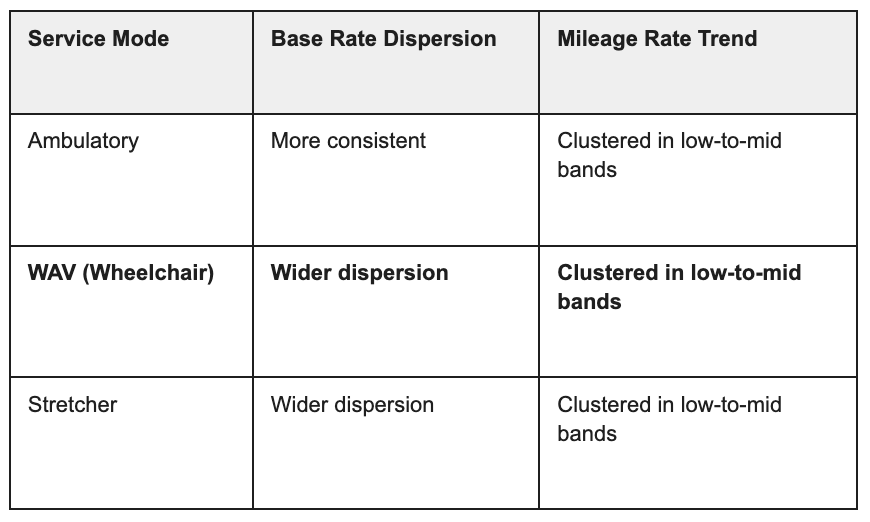
Different service types see different levels of rate consistency.
Shared Experience: If you feel like your margins are disappearing, you are not alone; the results suggest this experience is "widely shared" across the NEMT system.
.png)
See the full interview on YouTube
Please don't forget to subscribe and like NEMT Experts Podcast on YouTube.
Also, available to watch on Spotify
And listen (audio only) on your other favorite podcast platforms Apple and Pandora.
In this Episode 103 of the NEMT Experts Podcast, we talk with Kourtney Hayes, the founder of Patient Transportation in Birmingham, Alabama, on how she's hustled and rapidly grown her NEMT business focused on private pay and direct facility contracts.
Private pay growth can start through ambulance overflow
Courtney’s first private-pay trip came from an ambulance company that couldn’t take a non-emergency call, opening the door to community referrals.
Facility contracts came from persistence and visibility, not formal pitches
Repeated in-person visits built familiarity, leading a facility to call Courtney when another provider failed to show up.
Controlled growth is critical as fleets expand
As Patient Transportation scaled from 2 to 7 vans, Courtney emphasized learning when to say no, managing scheduling density, and avoiding overcapacity issues.
Kourtney Hayes
“Have you reached out to ambulance companies? Because I’m sure they get a lot of calls that they can’t take.”
Kourtney Hayes
“I guess I had been going to the facility so often that one day they just called me.”
Kourtney Hayes
“It’s okay to say no. If you have good rapport with a facility, they’ll call you again.”
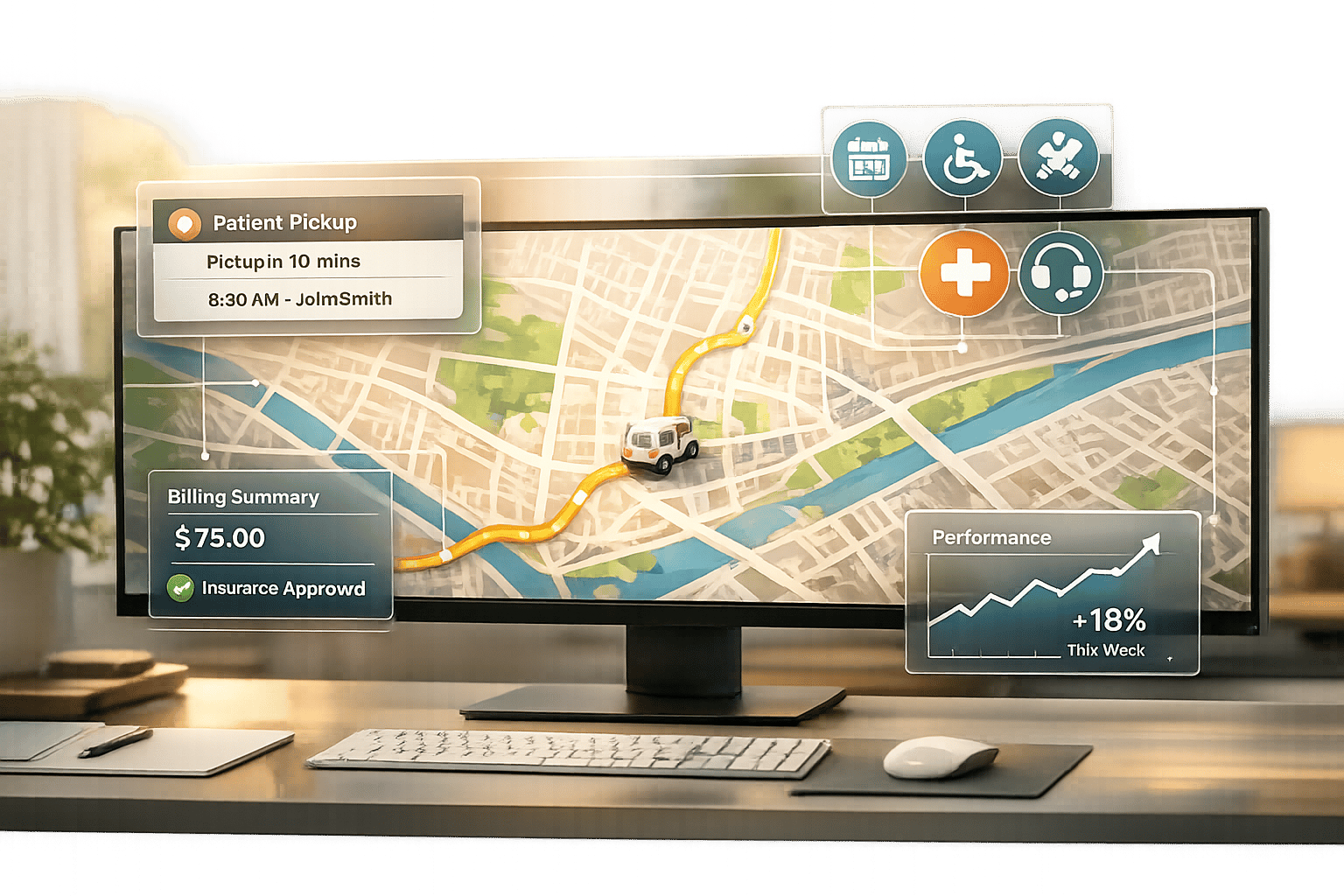
Managing non-emergency medical transportation (NEMT) can be challenging, but the right scheduling platform can simplify operations and improve service quality. Here’s what to prioritize:
These features save time, reduce costs, and improve patient satisfaction, making them essential for any NEMT provider.
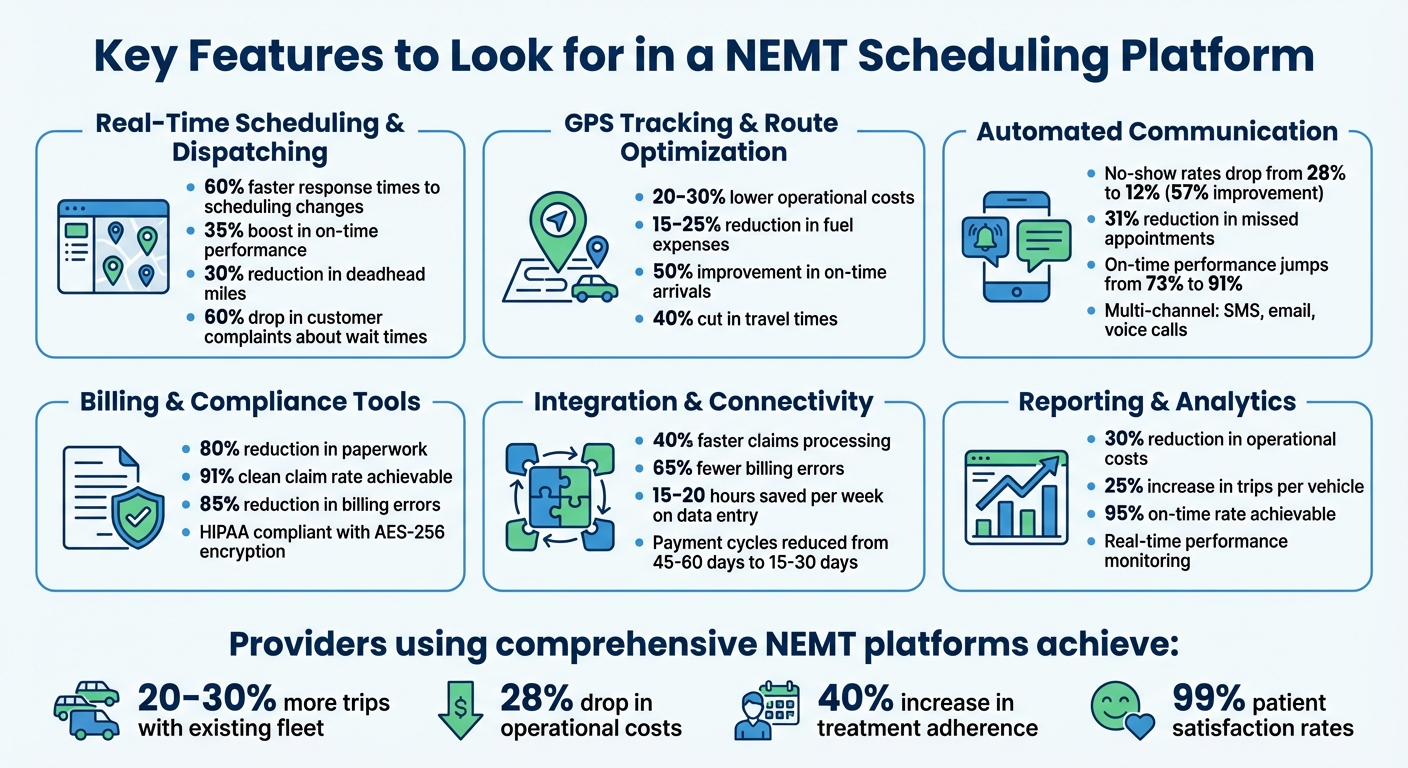
6 Essential Features of NEMT Scheduling Platforms
Real-time scheduling and dispatching bring clarity and control to what could otherwise be chaos. With a centralized dashboard, dispatchers can monitor every vehicle, driver, and trip as they happen. This setup enables them to assign the closest available driver to a new trip request instantly, using live GPS tracking and up-to-the-minute traffic updates. The result? 60% faster response times to scheduling changes and a 35% boost in on-time performance.
The system continuously tracks the entire fleet, ensuring seamless adjustments when unexpected events occur. For instance, if a trip gets canceled or a new one comes in, drivers are reassigned based on factors like proximity, vehicle type, and patient requirements. Advanced AI recalibrates routes the moment conditions shift, ensuring the most efficient paths are taken. Even in cases of vehicle breakdowns, dispatchers are alerted instantly and can assign a nearby driver to step in, minimizing service disruptions. This real-time adaptability makes on-the-fly scheduling adjustments smooth and effective.
In the world of transportation, last-minute cancellations, urgent ride requests, and unexpected delays are the norm. Dynamic reassignment tools step in to handle these challenges instantly. Features like accommodating last-minute return trip requests integrate these rides into existing schedules by identifying the nearest available driver. This approach reduces "deadhead miles" - the distance traveled without passengers - by 30%, cutting fuel expenses and improving overall fleet efficiency.
These enhancements in scheduling don't just streamline operations - they directly improve the patient experience. By factoring in real-time traffic and weather conditions, the platform reroutes drivers to avoid accidents or construction zones, ensuring timeliness even during disruptions. Meanwhile, automated SMS updates provide patients with live ETAs, reducing anxiety and eliminating the need for "where’s my ride" calls.
"Real-time trip management in NEMT means you always know what is happening with your vehicles, your drivers, and your passengers at every moment." - NEMT Platform
The results speak volumes. A New York-based NEMT provider serving Medicaid patients introduced real-time tracking and experienced a 60% drop in customer complaints about wait times. In California, another provider saw a 40% reduction in late pickups thanks to automated route optimization designed to avoid traffic jams. Beyond improving satisfaction, these advancements have a deeper impact: they increase treatment adherence by up to 40% and help lower hospital readmission rates.
Expanding on the benefits of real-time dispatching, GPS tracking takes operations to the next level by fine-tuning routes and monitoring driver activity. It plays a key role in fleet management by helping reduce fuel expenses, cutting down travel times, and holding drivers accountable. When scheduling platforms integrate real-time traffic and weather updates, they can instantly redirect drivers to avoid accidents, construction zones, or traffic jams, ensuring the quickest route is taken. Additionally, real-time location data allows the system to assign the closest available driver for each pickup, while grouping passengers whenever possible. This can lower operational costs by as much as 20% to 30%.
For example, in 2025, a midsize transportation provider in Texas reported saving over $50,000 in fuel costs within just six months, while also increasing their monthly trip volume by 25%. Across the industry, companies that adopt advanced route optimization systems often experience a 15% to 25% reduction in fuel expenses.
Real-time traffic data is a powerful tool for maintaining efficient routes, especially when paired with dynamic dispatching. If a patient cancels or a new trip is added, the system recalculates the best routes for the entire fleet based on live road conditions. This approach can improve on-time arrivals by as much as 50% and cut travel times by up to 40%. By combining live traffic updates with historical traffic patterns, these systems can deliver highly accurate arrival estimates, which not only enhance coordination with medical facilities but also help ease patient concerns.
GPS tracking offers dispatchers a clear, real-time view of their fleet, making it easier to address delays or unexpected issues. It also tracks driver behaviors like speeding, harsh braking, and excessive idling - factors that can hurt fuel efficiency and lead to faster wear and tear on vehicles. Geofence alerts are another valuable feature, notifying dispatchers if a vehicle strays from its optimized route, ensuring drivers stick to the most efficient path. Digital trip records, which log GPS data, signatures, and timestamps, create a reliable audit trail. Some advanced systems even work offline, ensuring continuous route visibility regardless of connectivity. These monitoring tools not only contribute to better on-time performance but also provide the transparency needed to elevate service delivery to the next level.
Staying on top of communication is just as vital as optimizing routes. One of the biggest challenges in the industry is no-shows, which manual vs. automated NEMT scheduling tools aim to address. No-show rates for NEMT providers typically range from 15% to 30%, with about 40% of these missed trips caused by communication issues. When patients don’t get clear reminders or real-time updates, they either forget their appointments or aren’t prepared when the driver arrives. The cost adds up quickly - each no-show costs providers anywhere from $45 to $85.
Automated systems help bridge this gap by sending notifications through SMS, email, and even voice calls. Many of these tools allow patients to confirm, cancel, or reschedule their rides directly from the notification, which means dispatchers can reassign vehicles without extra manual work. GPS-enabled real-time ETA updates also keep patients and healthcare facilities informed about arrival times, easing the stress of waiting and ensuring patients are ready when the driver arrives. The results? Let’s look at some real-world examples.
In 2025, a major regional healthcare network serving over 150,000 patients adopted smart scheduling with automated reminders and tracking. Within six months, their no-show rate plummeted from 28% to 12% - a 57% improvement. This translated to 2,400 more completed trips annually. Patient satisfaction scores also soared from 3.2 to 4.6 out of 5. Similarly, a small family-run NEMT company with 12 vehicles covering a rural 200-mile area saw missed appointments drop by 31%, while their on-time performance jumped from 73% to 91% in just three months after introducing automated communication systems.
Reaching patients through multiple communication channels ensures no one is left out. For instance, older adults might prefer automated voice calls, while younger patients are more likely to respond to SMS. Platforms should include features like "Reply 1 to Confirm" or "Reply 2 to Cancel", which feed directly into the dispatch system without needing staff to step in. Two-way messaging adds even more flexibility, allowing drivers to share updates about specific pickup locations or delays. Patients can also use it to provide gate codes or special assistance requests.
Facilities benefit too. Automated notifications sent to clinics or dialysis centers help staff prepare for incoming patients, improving coordination and reducing wait times.
To make a system truly inclusive, accessibility features are key. These might include screen reader compatibility, voice command options, adjustable text sizes, and high-contrast interfaces for those with visual or cognitive impairments. Multi-language support is another must-have, ensuring non-native speakers can understand trip details and instructions. Providers who prioritize accessibility report impressive outcomes, such as a 40% drop in patient wait times and a 25% boost in satisfaction scores.
Equally important is protecting patient data. All communication must use encrypted channels - AES-256 encryption for storage and TLS 1.2+ for data in transit - to safeguard sensitive health information and maintain HIPAA compliance.
Billing and managing HIPAA compliance often leave providers buried under mountains of paperwork and payer demands. A well-designed platform can simplify these processes by automating trip documentation and claim submissions. Automated trip documentation captures real-time pickup and drop-off times, GPS-verified mileage, and electronic patient signatures, cutting out the need for manual data entry and reducing errors. Providers who adopt automation have seen an 80% reduction in paperwork. This technology integrates smoothly with scheduling and dispatch systems, creating a streamlined workflow.
Take Metro Medical Transport as an example. This mid-sized provider, operating in three states, was grappling with a 23% claim denial rate in early 2024, which even led to losing a critical Managed Care Organization contract. To prevent revenue loss from such setbacks, providers must address billing errors and no-shows. By switching to a platform with GPS tracking and automated claim submission, they achieved a 91% clean claim rate, reduced denials to just 6% within six months, and boosted their monthly revenue by $200,000. Raquel Purvis, owner of Goodwill Transportation Services, shared her experience:
"One of my biggest issues before utilizing them was billing. They handle that process with ease, ensuring all claims are filed timely and fix errors as needed quickly to ensure timely payments."
Modern billing tools transform trip data into claims ready for submission. Route reconstruction APIs regenerate the actual route taken and compare it to pre-approved routes, ensuring Medicaid compliance and avoiding billing discrepancies. These systems automatically format claims to meet payer-specific requirements, using standard forms like CMS-1500 or electronic EDI formats. Additionally, real-time eligibility verification ensures that patient coverage is confirmed before services are provided, preventing denied reimbursements.
Direct API connections with major brokers eliminate the need for manual data entry, reducing disputes and streamlining operations. Built-in claim scrubbing tools catch errors before submission, improving clean claim rates and speeding up payment cycles. For instance, Green Med Trans Inc. utilized these features to achieve a 99.2% claim approval rate while managing over 5,000 trips each month. On top of that, automated systems can save providers 2 to 3 hours of administrative work every day.
Beyond billing, integrated compliance management is essential for safeguarding both businesses and patients. Platforms must adhere to strict HIPAA standards, including AES-256 encryption for data storage, TLS 1.2+ for data transmission, two-factor authentication, and role-based access controls. Non-compliance can result in penalties of up to $1 million.
Automated audit trails are another key feature, creating tamper-proof logs of system access, data changes, and trip documentation - critical during regulatory audits. Credential and license management tools track driver licenses, vehicle insurance, and medical certifications, providing alerts for upcoming expirations. For example, Regional Transport Solutions uncovered $45,000 in fraudulent claims from inflated mileage reporting by two drivers. After implementing GPS verification and automated mileage tracking in 2025, the company recovered $38,000 through negotiations with payers and prevented further fraud. Rachel Green, owner of Careful Transportation, highlighted the benefits:
"The app's automated dispatching and billing features have helped us save time and reduce errors, while the real-time tracking and communication features have helped us provide better service to our clients."
Effective integration is the backbone of a smooth operation, especially when it builds on tools like streamlined scheduling and automated billing. Managing multiple systems - such as scheduling software, billing tools, GPS tracking and route optimization, and broker portals - can become a headache when these platforms don’t communicate effectively. The result? Your team wastes time manually re-entering data across systems. A well-integrated scheduling platform solves this issue by linking all your business tools through direct API connections, creating a seamless workflow from booking a trip to processing the final payment.
The financial benefits of integration are hard to ignore. Providers using broker-integrated software process claims 40% faster and experience 65% fewer billing errors compared to those relying on manual data entry. This technology also enables providers to secure 40% more broker contracts and increase trip volume by up to 75%. Payment cycles, which often take 45–60 days, can be cut down to just 15–30 days with integrated billing systems. Beyond simplifying operations, these integrations deliver measurable financial gains.
Seamless data synchronization is a game-changer for eliminating repetitive tasks. With direct API integration to major brokers like ModivCare, MTM, and Access2Care, trip requests automatically flow into your scheduling system - no manual re-entry needed. This automation can save your team 15 to 20 hours of data entry every week. Additionally, automated data exchanges between broker systems, dispatch tools, and billing platforms significantly reduce human errors and streamline claims processing. In fact, automated electronic claims processing can reduce billing errors by 85%.
Bidirectional synchronization takes it a step further. When a driver marks a trip as complete in their mobile app, that status is instantly updated across the broker’s system, your billing platform, and even the healthcare facility’s records. This real-time data sharing minimizes miscommunications that could lead to claim denials or contract disputes.
Modern platforms are designed to connect every aspect of your operations, using industry-standard protocols like HL7 and FHIR to securely exchange data with Electronic Health Records (EHR). This ensures that patient information and appointment details sync automatically. For billing, standards like EDI 837P for claim submissions and 835 for electronic remittance advice accelerate the revenue cycle while maintaining compliance. Integration with accounting tools like QuickBooks can further simplify invoicing and financial reporting.
| Integration Type | Standard/Tool Used | Key Benefit |
|---|---|---|
| EHR/EMR | HL7, FHIR, secure APIs | Accurate scheduling & care coordination |
| Billing | EDI 837P/835, CMS-1500 | Faster reimbursements & fewer denials |
| Broker | Direct API (ModivCare, MTM) | Automated trip import & status updates |
| Fleet/GPS | Telematics, Google Maps | Real-time visibility & driver safety |
| Accounting | QuickBooks, Stripe | Streamlined financial management |
This holistic approach boosts efficiency and reduces administrative burdens. Take Aerotranscare, for example: by integrating dispatch, billing, and broker communications into one platform, the company cut its call center workload by 40% while maintaining a 98% on-time pickup rate for over 3,000 monthly trips. The company’s owner, Raza, shared:
"Nemt Platform has been a blessing as I can plan my business operations in advance and it saves me a lot of time and energy".
Integration also simplifies compliance. Automated monitoring can reduce audit preparation time by as much as 70%, giving your team more time to focus on what matters most.
Once a scheduling platform is seamlessly integrated, its reporting and analytics features can become a game-changer for improving daily operations. These tools take raw data and turn it into actionable insights, helping you pinpoint what's working and where adjustments are needed. Instead of relying on guesswork, you can monitor specific metrics that directly influence both your service quality and financial performance.
The best reporting tools focus on the metrics that matter most to your operations. For example, keeping an eye on vehicle utilization - aiming for over 75% during peak hours - and maintaining on-time pickup rates above 90% are key indicators of efficiency. Industry data shows that many providers only reach about 35% utilization, leaving a lot of room for improvement. A reliable dispatch system should also notify managers when on-time performance dips below 90%.
Another critical metric is driver idle time, which highlights inefficiencies in scheduling or zone assignments. Cutting idle time from 25% to 12% can boost completed trips per driver by 15%. Then there's cost per trip, which factors in fuel, wages, maintenance, insurance, and overhead to give you a clear picture of profitability. Combining metrics like trip completion rates, cancellation rates, billing cycle times, and claim rejection rates with cost per trip can reveal where adjustments are needed.
| Metric | Formula / Definition | Operational Goal |
|---|---|---|
| Vehicle Utilization | (Time with passengers ÷ Total available time) × 100 | > 75% during core hours |
| On-Time Pickup | (Trips picked up on time ÷ Total trips) × 100 | > 90% |
| Driver Idle Time | Time available but not moving passengers | < 10% of working hours |
| Cost per Trip | Total Operating Costs ÷ Total Trips | Trend downward with better routing |
| Trip Completion | (Completed trips ÷ Total scheduled trips) × 100 | Maximize by lowering no-shows |
These metrics provide a solid foundation for identifying areas where operations can be fine-tuned.
Once you've established these benchmarks, analytics can help you address problems before they escalate. For instance, idle time reports can guide you in reassigning drivers from low-demand zones to busier areas. Reviewing late-arrival data can reveal whether delays are due to systemic issues or specific drivers. Monitoring vehicle downtime and scheduling preventative maintenance can also minimize unexpected disruptions. Advanced platforms even predict periods of high demand, allowing you to schedule drivers and vehicles more effectively.
The financial benefits of using data to optimize operations are striking. Analytics and route optimization can cut operational costs by up to 30% and reduce fuel expenses by 25%. For example, MedTransport Solutions achieved a 40% cost reduction, increased trips per vehicle by 25%, and maintained a 95% on-time rate. Similarly, CareRide grew its fleet from 10 to 30 vehicles - a 300% increase - while keeping the same number of dispatch staff and sustaining a 99% patient satisfaction rate through automation. As Evariste from Kinsemen Transport put it:
"The ability to see our business financials breakdown via brokers, corporate clients, dispatch jobs is simply awesome".
With dashboards offering real-time monitoring, you can focus on exceptions - trips falling outside performance targets - rather than combing through every detail. This shift from static weekly reports to live data allows for immediate adjustments, improving both efficiency and patient care. These insights not only streamline operations but also reinforce the platform's value in delivering high-quality service.
Modern NEMT platforms bring together a suite of features that transform how operations are managed. AI-driven scheduling and route optimization allow providers to handle 20–30% more trips with their existing fleet. With GPS tracking, dispatchers access live location data, enabling automated notifications to give patients accurate ETAs. This same technology helps adjust routes in real time to account for traffic or cancellations, significantly cutting down on no-shows and easing dispatcher workloads.
Beyond efficiency, seamless integration is a game-changer. By linking dispatch systems with billing and compliance tools, trip data automatically connects to claims, reducing manual tasks and speeding up reimbursements. Meanwhile, reporting and analytics tools gather insights from various data points - like scheduling, fuel usage, and driver behavior - to identify operational bottlenecks and guide improvements over time. Providers have seen impressive results, including a 35% boost in on-time performance, a 28% drop in operational costs, and fuel savings ranging from 15% to 25%.
These advancements aren't just about efficiency - they also enhance patient care. As Brent D. Payne from MediDrive puts it:
"Modern NEMT platforms are revolutionizing healthcare transportation through advanced features that enhance operational efficiency and patient care".
The best platforms do more than automate - they create a feedback loop where each trip generates data to refine operations further. When choosing the right NEMT dispatch software, focus on integration capabilities, multi-channel communication, and real-time visibility to ensure all features work together seamlessly.
The financial benefits are undeniable. Multi-location operations often see rapid returns on investment. Reliable transportation also improves patient outcomes, increasing treatment adherence by up to 40% and reducing hospital readmissions. Ultimately, a well-rounded NEMT scheduling platform not only boosts profitability but also strengthens the communities it serves, delivering better care while driving operational success.
Real-time scheduling plays a key role in making Non-Emergency Medical Transportation (NEMT) services more efficient. It provides instant updates and allows for quick changes to trip plans. This means fewer delays, better route planning, and accurate ETAs shared with both passengers and drivers.
By simplifying operations, real-time scheduling reduces disruptions, improves punctuality, and enhances overall service dependability. It’s an essential solution for handling the ever-changing needs of NEMT providers while ensuring passengers receive consistent and reliable care.
GPS tracking plays a key role in making Non-Emergency Medical Transportation (NEMT) scheduling more efficient by offering real-time updates on vehicle locations. With this data, dispatchers and drivers can quickly adapt to changes like traffic jams, road closures, or unexpected delays, keeping trips on schedule and running smoothly.
By pinpointing the best routes, GPS tracking helps cut down on extra mileage, saves on fuel costs, and reduces delays. It also maximizes the use of fleet resources while maintaining timely service - a crucial factor for meeting compliance standards and providing dependable transportation. This technology streamlines operations and ensures patients relying on NEMT services receive consistent, high-quality care.
Automated communication features in NEMT scheduling platforms play a crucial role in reducing no-show rates by keeping patients consistently informed and engaged. Tools like automated reminders and real-time updates ensure patients know their pickup times, driver locations, and any changes in their schedules. This reduces the likelihood of missed trips and helps appointments run more smoothly.
Real-time communication tools also make it easier to address unexpected delays or issues. They enable quick coordination between dispatchers, drivers, and passengers, ensuring problems are resolved efficiently. By streamlining the flow of information and promoting accountability, these systems build trust and reliability - encouraging patients to stick to their scheduled rides.
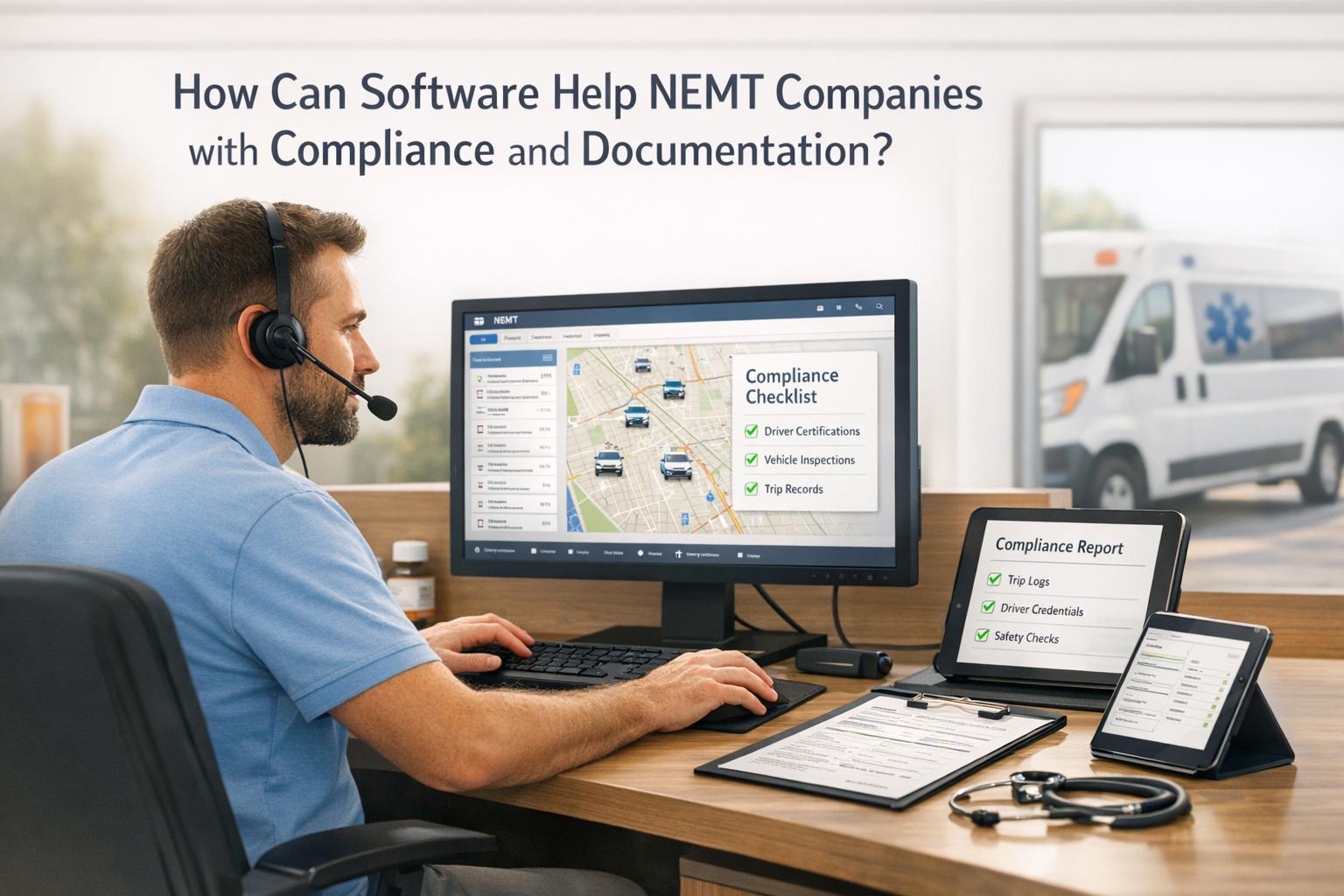
Running a Non-Emergency Medical Transportation (NEMT) business comes with strict compliance and documentation demands. Software solutions simplify these challenges by automating processes, reducing errors, and ensuring providers meet regulatory requirements. Here's how:
Providers using these tools report fewer claim denials, increased revenue, and smoother audits. For example, Metro Medical Transport reduced claim denials from 23% to 6%, adding $200,000 in monthly revenue. The right software keeps your operations compliant while saving time and money.

Manual vs Automated NEMT Compliance: Key Differences
Modern Non-Emergency Medical Transportation (NEMT) software takes the hassle out of compliance by automating processes that were once manual and error-prone. Instead of juggling spreadsheets and paper files, providers can now manage everything - driver credentials, vehicle inspections, and more - on a single, centralized platform. This shift significantly reduces manual errors that often lead to claim denials or audit complications.
Automation can save providers a considerable amount of time. In fact, billing and documentation tasks that used to take hours or even days can now be completed in just a few clicks, cutting time spent on these activities by up to 75%. Digital records are instantly accessible, securely stored, and properly timestamped, making compliance simpler and more reliable.
One of the biggest advantages? The software actively works to prevent compliance issues before they escalate - helping providers avoid costly service interruptions or fines.
Keeping track of driver certifications, vehicle maintenance schedules, and daily vehicle inspection reports (DVIRs) can be overwhelming. NEMT software takes over these responsibilities, logging all credentials digitally and sending reminders when expiration dates approach. This ensures that no driver is accidentally dispatched with expired certifications.
"Credential management software ensures that all driver and vehicle documents are up to date by sending automated alerts and reminders." – NEMT Cloud Dispatch
Vehicle maintenance also becomes more predictable. The software tracks mileage in real time and schedules preventive maintenance based on actual usage instead of guesswork. Drivers can complete DVIRs using mobile apps, with the data syncing instantly to a central system. This eliminates the need for manual logs, which are often inaccurate and can lead to unplanned breakdowns or safety violations.
| Feature | Manual Documentation | Automated NEMT Software |
|---|---|---|
| Record Entry | Paper-based, prone to human error | Digital, paperless, and automatically recorded |
| Credential Tracking | Manual spreadsheets; easy to miss expirations | Automated alerts and renewal reminders |
| Trip Verification | Relies on driver logs and self-reporting | Real-time GPS tracking and digital timestamps |
| Billing Accuracy | High risk of claim denials due to typos | One-time entry with real-time validation rules |
| Audit Preparation | Days of gathering physical files | Audit-ready records accessible in clicks |
| Vehicle Safety | Irregular maintenance checks | Daily digital DVIRs and maintenance logs |
This automated record-keeping seamlessly integrates with real-time monitoring, ensuring compliance is maintained across all operations.
Real-time monitoring provides providers with a clear, up-to-the-minute view of their compliance status. The software continuously tracks driver certifications, vehicle inspections, and insurance coverage, flagging any credentials that are about to expire - or that have already lapsed. Dashboards give managers instant access to their operation's compliance status, offering peace of mind and better control.
Some systems take it a step further by matching driver qualifications to specific patient needs. For example, if a patient requires Basic Life Support (BLS) or Advanced Life Support (ALS), the software ensures only appropriately certified crew members are assigned. This reduces the risk of mismatches and regulatory violations.
Additionally, the software performs regular eligibility checks - weekly or monthly - to confirm that drivers and vehicles meet Medicaid and state requirements. GPS integration tracks vehicle mileage and diagnostic codes in real time, allowing maintenance to be scheduled based on actual usage rather than arbitrary intervals. This level of precision ensures that operations stay compliant while minimizing downtime.
Ensuring data security is critical for protecting PHI (Protected Health Information) and maintaining compliance with HIPAA regulations. It's also a cornerstone for audit readiness in NEMT (Non-Emergency Medical Transportation) operations.
Securing patient information isn't just a good practice - it's a legal obligation under HIPAA. NEMT software plays a key role here by embedding strong security measures throughout the system, from dispatching and billing workflows to mobile driver apps.
Modern platforms use advanced encryption standards like AES-256 and TLS 1.2+ protocols to safeguard PHI, whether it's stored or being transmitted.
Role-Based Access Control (RBAC) ensures that employees only see information relevant to their roles. For instance, drivers access trip details but not sensitive medical notes, while billing staff can view claims data without seeing unnecessary patient information. Additional layers of security, like Multi-Factor Authentication (MFA) - using text codes or biometric scans - and automatic session timeouts, help prevent unauthorized access. Together, these measures provide a strong foundation for audit preparation, which is explored further below.
Beyond encryption and access controls, maintaining detailed audit trails is essential for meeting regulatory requirements and passing audits without complications.
Accurate documentation is key to avoiding penalties during audits. With NEMT software, providers can quickly generate detailed reports using immutable, time-stamped logs. These logs securely store everything from trip records to electronic signatures and medical necessity documentation in the cloud. This centralized, searchable system eliminates the inefficiencies and errors that often come with manual record-keeping.
To enhance compliance, the software assigns unique user IDs to track every employee's activity, making it easier to trace any suspicious actions. Some platforms even incorporate AI-powered monitoring to flag unusual login attempts or potential security breaches in real time. Additionally, states like New York require GPS tracking - known as "breadcrumb data" - to document pickup and drop-off coordinates along with timestamps. Compliant software automatically captures and shares this information with transportation managers, reducing the risk of fraud.
| HIPAA Requirement | NEMT Software Capability |
|---|---|
| Access Control | Unique User IDs and Role-Based Permissions |
| Integrity | Digital signatures and encrypted data transfers |
| Audit Controls | Immutable logs of all PHI access and changes |
| Transmission Security | SSL/TLS encryption for data sent to driver apps |
| Automatic Log-off | Session timeouts after inactivity |
To further minimize risks, providers should conduct regular compliance checks, schedule third-party audits, enforce password updates, and require MFA. Limiting the PHI visible on driver apps to only what's needed for safe transport also reduces exposure if a device is lost or stolen.
AI-driven scheduling tools are reshaping how NEMT companies stay compliant while meeting tight service deadlines. These systems can analyze over 100 routes in less than three seconds, optimizing driver assignments and minimizing delays. Manual dispatching often falls short, potentially overlooking certification requirements or creating inefficient routes. In contrast, AI automates this complex process, even matching specialized trip needs to drivers with the right skills.
With automated record-keeping at its core, the AI system ensures that only qualified drivers are assigned to trips. It evaluates factors like traffic conditions, driver certifications, and patient medical needs to create schedules that meet compliance standards. For instance, if a trip requires wheelchair accessibility or specific medical equipment, the AI ensures the driver has the proper credentials and vehicle, avoiding mismatches that could lead to violations. This seamless integration with credentialing modules means every trip assignment is verified for compliance before dispatch.
When unexpected issues arise, real-time adjustments keep operations running smoothly. If traffic or accidents cause delays, the system recalculates ETAs, suggests alternate routes, and ensures adherence to strict pickup and drop-off windows mandated by state regulations and payer contracts. Companies using these platforms report on-time pickup rates as high as 98% to 99%.
AI-powered systems also significantly reduce inefficiencies. By cutting empty miles by 40%, these tools improve operational efficiency. GPS tracking adds another layer of accountability, creating tamper-evident records of routes taken. This feature is especially critical in areas with strict Medicaid guidelines. For example, Metro Medical Transport adopted integrated NEMT software in early 2024, leveraging GPS tracking and automated scheduling to increase their clean claim rate to 91% and lower denial rates from 23% to 6% in just six months. This improvement translated to an additional $200,000 in monthly revenue.
"Our advanced AI engine optimizes medical transport routes 20 moves ahead, considering traffic patterns, driver expertise, and patient medical transportation needs." – RouteOps
NEMT software transforms compliance challenges into opportunities for growth. By simplifying operations, providers can reduce administrative tasks by 50% while ensuring 100% HIPAA compliance. This technology removes the risk of manual errors that often lead to claim denials and regulatory issues, producing audit-ready records for every trip.
Take CareRide, for example. This urban NEMT provider expanded its fleet from 10 to 30 vehicles - a 300% increase - without needing to hire more dispatch staff. Even with this growth, they maintained a 99% patient satisfaction rate. These advancements allow teams to prioritize delivering quality care instead of being bogged down by administrative work.
Start by setting up automated alerts for driver certifications and vehicle inspections through your dashboard. Use real-time monitoring tools to stay ahead of potential issues. Require drivers to use mobile apps for tasks like mileage logging and digital signatures, cutting out the need for manual paperwork. Opt for a platform that combines dispatch, scheduling, and billing to eliminate redundant data entry and ensure smooth documentation through automated record-keeping and AI-driven scheduling.
Leverage KPI dashboards for monthly audits to catch problems early, and designate a Compliance Officer to stay updated on regulatory changes, such as the HCPCS S0215 requirement set to take effect on July 1, 2025.
NEMT software plays a crucial role in maintaining HIPAA compliance by incorporating advanced measures to safeguard sensitive patient data, also known as Protected Health Information (PHI). Some of the standout features include:
Many platforms also simplify compliance with automated record-keeping and compliance reporting tools, which reduce the chances of human error and make documentation more efficient. Regular software updates further ensure the system stays aligned with the latest HIPAA regulations, closing any potential compliance loopholes.
However, software alone isn't enough. NEMT providers should prioritize staff training and conduct internal audits to reinforce compliance efforts. Combining these strategies ensures patient data is protected and federal standards are consistently met.
AI is transforming Non-Emergency Medical Transportation (NEMT) operations by streamlining processes and minimizing errors. By automating tasks like scheduling and dispatching, AI analyzes critical factors such as traffic patterns, driver availability, and patient requirements. The result? Smarter route planning, fewer unnecessary miles, and a significant boost in efficiency. Plus, these systems can make real-time adjustments to keep trips running smoothly and on schedule.
On the compliance side, AI simplifies some of the most tedious tasks, like documentation and billing. It automatically logs trip data, cross-checks routes with approved plans, and reduces mistakes, making audits less of a headache and lowering the risk of regulatory issues. Features like real-time GPS tracking and dynamic rerouting add another layer of reliability, ensuring services are punctual, safe, and meet all necessary standards - all while lightening the administrative load for NEMT providers.
Real-time monitoring plays a crucial role in helping NEMT companies maintain compliance. It offers continuous visibility into vehicle locations, driver actions, and trip progress. This level of oversight ensures companies meet key regulatory requirements, such as punctual pickups and drop-offs, proper documentation, and adherence to safety protocols. By identifying potential issues as they arise, companies can address them immediately, minimizing errors, preventing violations, and avoiding costly penalties.
Beyond compliance, real-time monitoring allows for dynamic adjustments, such as rerouting to manage delays or confirming passenger pickups, all while keeping detailed and accurate records. These records, complete with timestamps and trip data, create a dependable audit trail that simplifies compliance tasks and makes audit preparation more efficient. This not only improves operational accuracy but also ensures that regulatory standards are consistently upheld.

NEMT (Non-Emergency Medical Transportation) dispatch platforms need features that solve real-world challenges like scheduling, communication, and compliance. The most useful customizable features include:
Platforms like Bambi, Platform X, and Platform Y offer these features, each catering to different needs. Bambi focuses on automation and ease of use, Platform X emphasizes cost savings with traffic-aware routing, and Platform Y excels with advanced AI scheduling and compliance integrations. Pricing varies, with Bambi starting at $69 per vehicle per month, while others use scalable or custom pricing models.
| Feature | Bambi | Platform X | Platform Y |
|---|---|---|---|
| Route Optimization | AI-powered with manual tweaks | Traffic-aware algorithms | Predictive AI scheduling |
| Communication Tools | Driver-dispatch chat, alerts | Push-to-Talk, VoIP | Real-time notifications |
| Scheduling | Automated, bulk uploads | Dynamic, API integrations | AI conflict resolution |
| Compliance | HIPAA, e-signatures | Secure storage, audit-ready | Broker API integrations |
| Pricing | $69/vehicle/month | Per-trip (scalable) | Custom based on fleet size |
Choosing the right platform depends on your priorities - whether it's automation, cost-efficiency, or advanced AI capabilities.

NEMT Dispatch Platform Comparison: Bambi vs Platform X vs Platform Y Features and Pricing
Bambi's "Run Bambi Run" leverages AI to create instant, optimized schedules for trip requests. The system evaluates real-time factors like driver location, vehicle type (such as wheelchair accessibility), capacity, and special equipment requirements to pair the right driver with the right trip. It also dynamically adjusts routes to accommodate new trip requests, traffic updates, and navigation changes. This reduces travel distances and cuts down idle time between trips by optimizing NEMT routes.
The platform supports bulk scheduling, allowing users to manage anywhere from 10 to 10,000 trips at once. With constraint-based scheduling, only certified crews and properly equipped vehicles are assigned to specific trips, improving both operational efficiency and the rider's experience.
"Trip count has gone up. Efficiency has gone up." – Adham Harb, Operations Manager, CareTrips
Effective communication is just as important as route optimization. Bambi's platform includes a direct driver-dispatch chat, enabling instant communication without the need for constant phone calls. Customizable SMS and push notifications alert teams about location changes, delays, or new equipment needs. Drivers, dispatchers, and riders stay connected through dedicated iOS and Android apps, ensuring everyone is on the same page.
Offline GPS-stamped events are another standout feature, addressing "GPS blind spots" by maintaining accurate journey records and performance tracking even in areas with poor connectivity. This innovation earned Bambi the NEMTAC Innovation in NEMT Award in 2025.
"Everything was right there in front of you. And literally, my lead driver told me it's perfect... they can now make adjustments on their route." – Cho Ndiforchu, Owner at Skyline Transport
Bambi also simplifies scheduling with features like recurring trip automation and mass uploads. As new requests come in, the AI suggests the best possible assignments to keep operations running smoothly.
"It's the easiest and best system that we have ever worked with scheduling wise." – Christina, Plan B Express Transit
Compliance is baked into the platform, with automated HIPAA features like GPS-stamped timestamps, e-signatures, and a detailed audit history of system changes. Pre-shift vehicle inspection tools ensure that fleet safety and operational standards are met before drivers hit the road.
Bambi integrates seamlessly with major NEMT brokers like SafeRide and Modivcare, streamlining trip intake and reporting. The pricing model is straightforward at $69 per month per vehicle, with no hidden fees, no contracts, and no onboarding costs. With a 5.0/5.0 star rating across platforms like G2, Capterra, and Software Advice, Bambi has established itself as a trusted tool for hassle-free NEMT operations.
Platform X takes route planning to the next level by analyzing pickup and drop-off points alongside patient-specific needs using true NEMT route optimization. It pulls in live traffic and weather data to automatically reroute drivers, ensuring efficiency even when cancellations or new requests pop up. By grouping compatible trips into a single route, it dynamically adjusts based on factors like geolocation, vehicle type, and driver availability.
The results? Providers often see a 20% to 30% reduction in operational costs and a 15% to 25% cut in fuel expenses. On-time arrivals can improve by up to 50%, while driver utilization rates leap from under 60% to over 85%. Plus, deadhead miles - the distance traveled without passengers - can be slashed by 30%.
Platform X enhances communication with its built-in Push to Talk feature, designed to simplify interactions between dispatchers and drivers. It also supports VoIP, enabling seamless digital voice calls.
Administrators can set up personalized pop-up alerts, reminders, and notifications via SMS or email to keep everyone updated on trip statuses and driver activities. Third-party SMS tools automatically generate alerts when trip statuses change, ensuring drivers and patients stay informed. A driver chat feature lets dispatchers send direct messages about specific trips or routes.
"NEMT Push to Talk application is designed to improve the efficiency and quality of NEMT services by overcoming the issues of communication between drivers and dispatchers." – NEMT Cloud Dispatch
This communication system supports smooth, real-time updates and scheduling adjustments.
With its dynamic routing and robust communication tools, Platform X also simplifies NEMT scheduling. It handles recurring orders and last-minute requests using algorithms that factor in proximity and vehicle type. Shift Schedules organize drivers by their availability, while historical data aids in pre-planned scheduling for the week ahead. Automated systems respond to scheduling changes 60% faster than manual processes.
Platform X doesn’t just streamline operations - it also integrates compliance at every step. It ensures HIPAA compliance by tracking certifications, capturing digital signatures, and automating reminders for legal documents and vehicle inspections. Integration with brokers like MTM and Modivcare automates eligibility checks and ensures trip assignments meet broker-specific requirements.
"Using their solution, I have been able to offer NEMT compliant services to some of the largest insurance brokers in Indiana State." – A Chaddarh, Hoosier Medical Transport
Platform Y takes route planning to the next level with its AI-driven predictive scheduling. By analyzing both historical and live data - like traffic patterns, road closures, and weather conditions - it identifies the best scheduling windows and recalculates routes dynamically. One standout feature is its automated conflict resolution, which prevents issues like double bookings or overlapping appointments, ensuring smoother operations.
Beyond efficient routing, Platform Y enhances communication with a customizable notification system. This module allows for tailored alerts to be sent to drivers, patients, and team members. Adding to its capabilities is Olivia, an AI-powered voice bot that manages calls, books rides, and provides automated updates. Dispatchers can also use real-time messaging to assign tasks directly to drivers’ devices, keeping everyone in sync.
Platform Y bolsters operational reliability with features designed for compliance. It digitally stores trip logs, patient signatures, and essential documents, ensuring they’re always audit-ready. The platform uses HIPAA-compliant encryption, access controls, and audit trails to safeguard sensitive patient data. Its broker API integrations with industry leaders like Modivcare, MTM, and Call the Car automates data transfers, reducing errors and streamlining compliance processes. This ensures the platform meets the rigorous demands of NEMT services while maintaining a high standard of reliability.
Let’s break down the strengths and weaknesses of each platform discussed earlier, highlighting what sets them apart.
Bambi AI-Powered NEMT Platform stands out with its AI Receptionist, slashing call center workloads by 40% and offering instant trip matching. Its sleek, modern interface earns a stellar 4.7/5 for ease of use.
Platform X shines with its traffic-aware routing algorithms, helping reduce fuel costs, and a flexible per-trip pricing model that scales with your business. However, it lacks advanced communication customization beyond standard dispatch tools.
Platform Y brings powerful AI-driven predictive scheduling, which includes automated conflict resolution to eliminate double bookings. Its broker API integration with Modivcare and MTM ensures smoother compliance and fewer billing errors.
"NEMT Platform has transformed the way we manage our transportation services. With features like real-time vehicle tracking and manual vs. automated route planning, our operations have become more efficient and effective." – Victoria Sean, Smart Transportation
Here’s a side-by-side comparison of each platform's standout features:
| Feature | Bambi AI-Powered Platform | Platform X | Platform Y |
|---|---|---|---|
| Route Optimization | AI-powered with manual adjustments | GPS-based with traffic algorithms | Dynamic algorithms with predictive scheduling |
| Communication Tools | AI Receptionist, instant trip matching | Push-to-Talk, VoIP, driver chat | Real-time vehicle tracking |
| Scheduling Flexibility | AI auto-scheduling with broker importers | Automated with API integrations | AI-driven with conflict resolution |
| Compliance Features | HIPAA-compliant encryption, digital signatures | Secure cloud storage, audit-ready reporting | HIPAA encryption, broker API integration |
| Pricing | $69/vehicle/month | Per-trip model (scalable) | Custom pricing based on fleet size |
| Best For | Providers seeking automation and a modern UI | Cost-conscious fleets focused on fuel efficiency | High-volume operations needing advanced AI tools |
Each platform offers a unique set of benefits tailored to different operational needs. Choosing the right NEMT dispatch software will depend on factors like the scale of your operations, your technical requirements, and whether you prioritize automation or cost savings.
When selecting a platform, it's essential to align your choice with your specific operational needs. For small to mid-sized providers, Bambi offers a flexible usage-based pricing model at $69 per vehicle per month, with no contracts. It also promises to lighten administrative workloads by up to 40% - a significant advantage for teams looking to streamline their operations.
Platform X is ideal for cost-conscious fleets, focusing on route optimization and cutting operational expenses. However, its communication customization options may feel limited for some users. Carefully weigh these features against your fleet's unique challenges to determine if it’s the right fit.
On the other hand, Platform Y leverages AI-driven scheduling tools to eliminate double bookings and improve on-time performance by 35%. Its broker API integration further simplifies compliance and ensures accurate billing - a crucial benefit for providers working with insurance brokers.
"NEMT Platform has been a tremendous help in taking my business to new levels. Using their solution, I have been able to offer NEMT compliant services to some of the largest insurance brokers in Indiana State." – A Chaddarh, Hoosier Medical Transport
To make the best decision, match the platform's features to your needs. Take advantage of trial periods to test each solution with your dispatchers and drivers, paying close attention to the user interface and mobile app performance. Focus on solutions that address scheduling inefficiencies, compliance hurdles, and communication gaps - all without the burden of long-term contracts.
AI-driven route optimization is transforming how NEMT providers operate by crafting smarter, more efficient routes. By analyzing real-time data - like traffic conditions, trip schedules, and vehicle availability - it helps reduce fuel expenses, cut down on unnecessary mileage, and ensure that pickups and drop-offs happen on time. The result? Greater reliability and a noticeable boost in service quality.
This technology also brings dynamic scheduling into the mix, making it easier to handle last-minute changes like cancellations or delays. Automated trip assignments and optimized dispatch processes mean less manual effort and better fleet efficiency. The benefits are clear: reduced costs, smoother operations, improved regulatory compliance, and a better experience for both drivers and passengers.
To meet industry regulations, a NEMT dispatch platform must have automated document management to handle vehicle and driver records effectively. This includes keeping track of licenses, insurance, and inspection dates, with timely reminders before expiration to avoid lapses. Accurate record-keeping is also essential, and integrated trip and service logs play a key role in maintaining detailed records for billing, audits, and compliance checks.
Another important feature is real-time GPS tracking, which allows you to monitor vehicle locations and driver activities. This not only enhances safety but also ensures adherence to operational standards. Automated compliance reporting tools further streamline the audit process by generating detailed reports and logs. Combined with integrated billing capabilities, these tools help ensure accurate documentation for reimbursements. Altogether, these features work to reduce risks, increase transparency, and keep your operations aligned with legal and industry requirements.
Effective communication tools are essential for boosting efficiency in NEMT services, ensuring smooth coordination among dispatchers, drivers, and patients. These tools provide real-time updates, helping to cut down on delays, avoid miscommunication, and reduce no-shows by keeping everyone on the same page throughout the transportation process.
Take mobile apps, for instance. They allow drivers to receive instant updates about trips, route adjustments, or emergencies, enabling them to respond quickly to changing circumstances. Features like status updates, in-app messaging, and the ability to collect electronic signatures at pickup make operations run more smoothly and improve the reliability of services. When integrated into dispatch systems, these tools not only simplify administrative tasks but also help NEMT providers deliver faster and more dependable transportation for patients.
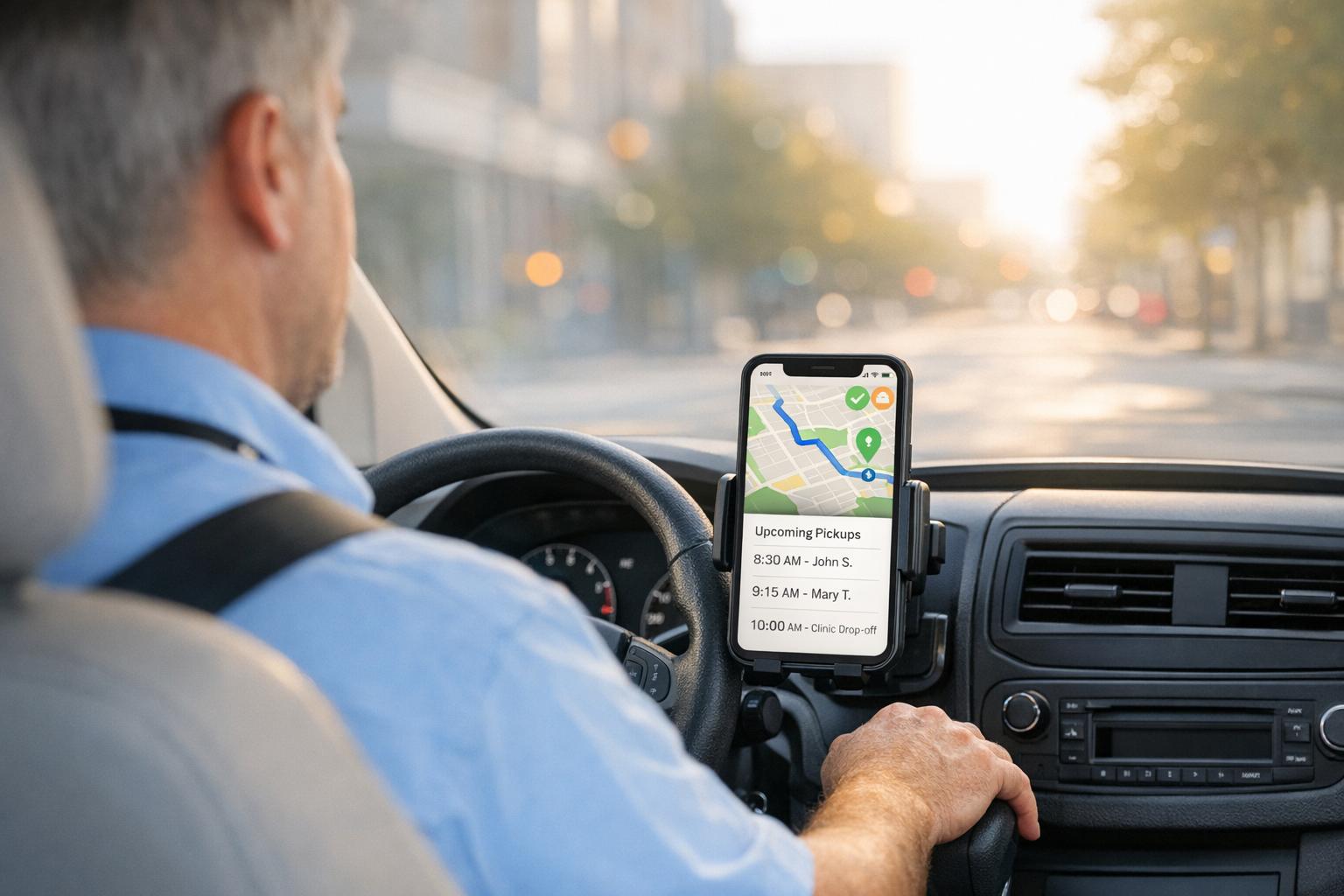
Mobile apps are transforming how Non-Emergency Medical Transportation (NEMT) drivers operate, making their jobs easier and services more efficient. Here's how they help:
These tools reduce costs, cut down errors, and improve both driver and passenger experiences, making NEMT services more reliable and efficient.

NEMT Mobile App Impact: Key Performance Metrics and Benefits
Timely arrivals are the backbone of NEMT services. Mobile apps address this need by integrating with navigation APIs like Google Maps to provide turn-by-turn directions that adjust automatically for traffic updates and road closures. This means drivers no longer need to guess the fastest route - the app uses real-time data to suggest detours around accidents or congestion.
The results speak for themselves. Aerotranscare, a NEMT provider managing over 3,000 trips monthly, achieved a 98% on-time pickup rate by using real-time tracking and route optimization tools. Similarly, Helping Hands Transportation improved to a 95% on-time arrival rate while reducing paperwork by 80%.
This kind of navigation efficiency also lays the groundwork for better tracking capabilities.
Live GPS tracking gives dispatchers a real-time view of their fleet. They can monitor each driver's location, check vehicle speed, and ensure route adherence as it happens. This is especially useful for last-minute "will call" trips - dispatchers can quickly assign the closest available driver, cutting down on unnecessary miles and keeping schedules on track.
Even when offline, apps continue to collect GPS data and timestamps, syncing everything once the connection is restored. Dispatchers can also review detailed "bread-crumb" trails after trips to confirm exact pickup and drop-off points. This helps resolve billing disputes and highlights inefficiencies like fuel-wasting patterns.
But tracking is only part of the equation - effective route planning takes operations to the next level.
Route planning software analyzes multiple variables, including distance, traffic conditions, appointment times, vehicle capacity, and specific patient needs like wheelchair accessibility. It calculates the most efficient route and can even handle multi-passenger schedules, which boosts vehicle utilization and reduces the total number of trips. This directly cuts down fuel costs and wear on vehicles.
For recurring appointments, such as dialysis, the software identifies patterns and creates standing schedules that improve fleet efficiency over time. Drivers receive clear, real-time directions, eliminating the need for constant check-ins with dispatchers and allowing them to focus on driving safely.
Handling trip schedules manually often overwhelms dispatchers with constant phone calls, paper-based trip sheets, and last-minute changes. Mobile apps simplify this process by using automated algorithms to match trips with the most suitable driver and vehicle in real time. These systems take into account factors like proximity to pickup points, vehicle capacity, specialized equipment (e.g., wheelchair lifts), and driver certifications.
By automating scheduling, administrative workloads can drop by as much as 50%. For example, one regional NEMT (Non-Emergency Medical Transportation) provider saw a 30% reduction in operational costs within the first year. This allows dispatchers to focus on urgent exceptions rather than routine scheduling tasks.
When a trip request is submitted, the app determines the best driver for the job. For on-demand trips, dispatchers can assign tasks with a single click. The software uses live GPS data and the driver’s current schedule to identify the closest available driver and sends the trip details directly to their device.
For patients with recurring appointments, such as those needing dialysis or physical therapy, the app recognizes patterns and suggests standing schedules. This eliminates repetitive data entry and ensures a seamless experience for both patients and providers.
"Lots of great features make our daily tasks very easy. The booking platform allows customers to book trips automatically." - Akandu Ukoha, Executive Director, Marcy Transportation Services
Once trips are scheduled, automated notifications keep all parties informed in real time.
Paper trip sheets are replaced with digital manifests that sync instantly across devices. Drivers receive updated manifests on their devices, removing the need for radio or phone confirmations.
Drivers can log their status - such as "Arrived", "Loaded", or "Dropped Off" - with just a tap. These actions automatically record GPS timestamps and odometer readings, creating a detailed audit trail without requiring manual input. Dispatchers can monitor trip progress on a live map, where color-coded icons show vehicles heading to pickups versus those en route to drop-offs. Push notifications ensure drivers are informed of new assignments or schedule changes without additional calls.
This automated system also streamlines billing. GPS-stamped events and electronic signatures are instantly converted into claim files, eliminating the need for manual data entry for Medicaid and Medicare reimbursements.
Effective communication between drivers and dispatchers is key to avoiding confusion and ensuring trips stay on track. Mobile apps have replaced traditional phone calls and radio check-ins with instant digital updates, allowing dispatchers to stay informed in real time.
"Eliminate distracting calls: Through our routing software drivers are updating trip status in real-time." - RoutingBox
Beyond real-time updates, mobile apps offer secure messaging features that create a direct and private communication channel between drivers and dispatchers. This two-way messaging system ensures confidentiality and keeps everyone up to date. Dispatchers can use these tools to send last-minute “will call” trips, share specific instructions, or make schedule changes directly to a driver’s device. With instant notifications, drivers receive updates without delay, helping them adapt quickly to changes.
Mobile apps don’t just connect drivers and dispatchers - they also keep passengers in the loop. Automated notifications via SMS, email, or phone inform passengers of estimated arrival times, reducing no-shows and cutting down on driver wait times. If delays arise due to traffic or other issues, the system updates passengers with revised arrival times, keeping them informed every step of the way. Additionally, apps can notify drivers when private payments - whether cash, credit card, or check - are due at the end of a trip. Passengers also receive instant updates about trip changes, reducing missed appointments and improving service reliability. These tools work together to streamline communication and ensure smoother daily operations.
Digital documentation, built on real-time trip updates and route data, plays a critical role in maintaining compliance while reducing human error. Accurate records are essential for NEMT audits and billing, and mobile apps have revolutionized this process by replacing traditional paper manifests. These apps automatically capture GPS points, odometer readings, and timestamps, creating a complete digital footprint that serves as solid proof of service during audits. This seamless digital trail integrates directly with advanced record management systems and compliance controls.
For example, Helping Hands Transportation achieved 100% compliance accuracy and cut paperwork by 80% after adopting digital coordination tools. Similarly, Green Med Trans Inc. reached a 99.2% claim approval rate while managing over 5,000 trips per month, demonstrating how automated documentation can significantly improve both compliance and reimbursement outcomes.
Drivers can now record compliance data directly on their mobile devices, simplifying the process while ensuring accuracy. Electronic signatures from passengers, facility staff, and drivers confirm trip completion and validate that services were delivered as required. Beyond this, apps include digital checklists for pre- and post-trip vehicle inspections, ensuring that critical safety measures - like brakes, lights, and wheelchair securement - are thoroughly verified.
To protect sensitive patient data, these systems use AES-256 and TLS 1.2+ encryption, meeting HIPAA standards and safeguarding information.
"It works well for Colorado minimum requirements on claim submission documentation.. Easy to use and reliable..my drivers love it." - Haron, Owner, Peak Elite Medride
With detailed digital records, billing becomes more efficient. The system automatically fills out necessary forms and codes, streamlining the process and reducing administrative burdens.
Billing is another area where digital tools shine. Apps can automatically generate CMS-1500 forms and EDI files for Medicaid and private insurers. These systems apply the correct billing and medical necessity codes, along with authorization numbers, minimizing errors that could lead to claim denials. Real-time eligibility verification ensures patient coverage is confirmed before a trip begins, avoiding non-reimbursable services.
"One of my biggest issues before utilizing them was billing. They handle that process with ease ensuring all claims are filed timely and fix errors as needed quickly to ensure timely payments." - Raquel Purvis, Owner, Goodwill Transportation Services
Integration with broker networks and accounting software like QuickBooks eliminates the need for redundant data entry, speeding up the reimbursement process. Drivers can also process payments - whether by credit card, cash, or check - directly through the app. Every transaction is logged, simplifying accounting tasks. When it’s time for an audit, providers can quickly generate comprehensive compliance reports that include the full history of trips, electronic signatures, and safety inspections.
Offline functionality plays a crucial role in ensuring uninterrupted service and accurate record-keeping, especially when drivers operate in areas with unreliable connectivity.
NEMT drivers frequently travel through rural or remote regions where cellular signals can be spotty or nonexistent. Apps tailored for these scenarios are designed to store critical data - like GPS coordinates, timestamps, and digital signatures - directly on the device. This means no information is lost, even if the internet connection drops. When the driver moves back into an area with stable connectivity, the app automatically syncs the stored data with dispatch and billing systems. This process creates a complete audit trail, ensuring compliance and preventing billing errors, while maintaining the efficiency of digital documentation.
Drivers can still access essential trip information, including passenger mobility requirements and scheduled routes, without worrying about connectivity issues. Events like GPS-stamped stops, passenger and staff signatures, and vehicle inspection checklists are securely logged on the device. Once the connection is reestablished, the app uploads all stored data to the administrative system, updating trip statuses and triggering the billing process. This smooth data transfer helps prevent delays or documentation gaps, even in remote service areas.
Apart from offline reliability, intuitive app design is key to making life easier for drivers. These apps are built with simplicity in mind, featuring large, easy-to-press buttons, color-coded status indicators, and straightforward navigation optimized for smartphones and tablets. Voice commands and AI-powered voice bots allow drivers to interact with the app hands-free, so they can stay focused on driving while receiving updates or confirming trip details.
"Mobile-optimized driver portals deliver critical trip information even in connectivity-challenged areas, while administrative dashboards transform complex operations into manageable workflows through intelligent visual design."
– MediDrive
To ensure usability in various lighting conditions, high-contrast interfaces and adjustable text sizes make screens easy to read, whether in bright daylight or dimly lit environments. Features like one-click "time in/time out" buttons, digital signature collection, and automated safety checklists streamline administrative tasks. Drivers can complete these actions quickly without navigating through complicated menus. Providers who have adopted these user-friendly features report a 40% decrease in patient wait times and a 25% boost in satisfaction scores.
Mobile apps have revolutionized NEMT (Non-Emergency Medical Transportation) operations by introducing tools like real-time GPS tracking, automated scheduling, direct messaging, and digital documentation. These features not only cut costs and reduce errors but also ensure compliance with industry standards. The results speak for themselves: providers have seen operational costs drop by 30% and customer satisfaction rise by 50%, thanks to smoother administration and better fleet management.
For drivers, these apps simplify daily tasks with user-friendly interfaces, offline capabilities, and safety checklists that safeguard both passengers and vehicles. Features like GPS-stamped events, electronic signatures, and automated time tracking eliminate cumbersome paperwork while ensuring accurate records. Additionally, multi-channel communication systems have lowered patient no-show rates by up to 50% and reduced patient wait times by 40%.
These advancements are setting the stage for significant industry growth. As NEMT continues to embrace AI-driven personalization and cloud-based solutions, mobile apps will remain at the heart of reliable service delivery and long-term business success. With these tools in hand, drivers can focus on their primary mission: providing safe and timely transportation for the patients who rely on them.
Mobile apps are a game-changer for NEMT drivers, helping them stay on top of compliance and cut down on mistakes. They offer tools like real-time GPS tracking, automated scheduling, and digital documentation, making daily tasks easier and more efficient.
With GPS tracking, drivers get precise navigation, reducing the chances of missed pickups or wrong turns. At the same time, dispatchers can keep tabs on vehicle locations in real time, ensuring everything stays on track.
Automated scheduling simplifies trip management by providing instant updates on changes, traffic, and route adjustments. This not only minimizes human error but also helps drivers stick to proper procedures. On top of that, digital tools let drivers handle pre- and post-trip checklists, log trip details, and confirm vehicle safety - all electronically. This improves record-keeping while cutting down on paperwork-related errors.
Together, these features make daily operations smoother, boost service reliability, and help drivers meet industry regulations with ease.
Offline functionality in NEMT driver apps ensures that essential features like trip information, navigation, and documentation remain accessible, even in areas with limited or no internet connection. This means drivers can stay on track and avoid delays caused by network disruptions.
Once the connection is restored, the app automatically syncs updates - such as trip statuses and location details - with dispatch systems. This is particularly helpful in rural or remote regions where cellular coverage is spotty, allowing drivers to maintain dependable service. By bridging communication gaps, offline functionality boosts efficiency and helps NEMT providers deliver consistent, high-quality service.
Real-time communication plays a key role in making Non-Emergency Medical Transportation (NEMT) services more efficient. It allows dispatchers and drivers to share updates instantly, ensuring drivers are always informed about pickups, drop-offs, route changes, or unexpected issues like traffic jams or delays. This quick exchange of information minimizes confusion and delays, helping to avoid missed appointments and keeping trips running on time.
For passengers, real-time tools offer accurate updates on arrival times, enhancing their overall experience and building trust. These systems also simplify operations by automating essential tasks such as scheduling, route planning, and vehicle tracking. The result? A smoother, more reliable process for both drivers and passengers.
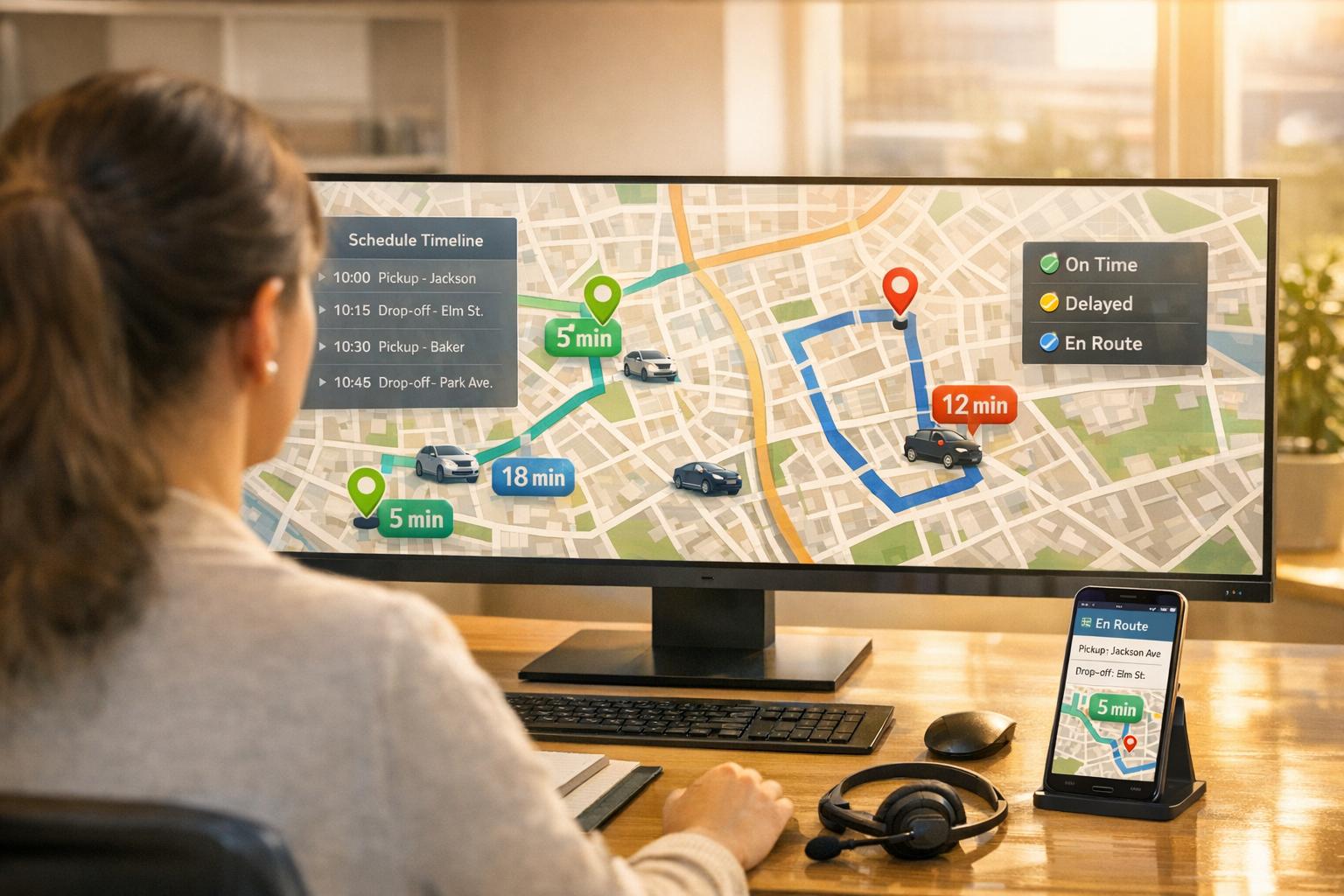
Real-time tracking helps NEMT (Non-Emergency Medical Transportation) dispatchers manage trips efficiently by using GPS, centralized dashboards, and AI tools. These systems show vehicle locations, trip statuses, and ETAs, allowing dispatchers to act instantly during delays or changes. Features like geofence alerts, automated scheduling, and mobile driver apps streamline communication and reduce errors. Key benefits include improved on-time performance, lower costs, and better service reliability.
Key Features:
These tools simplify operations, save time, and improve passenger experience.
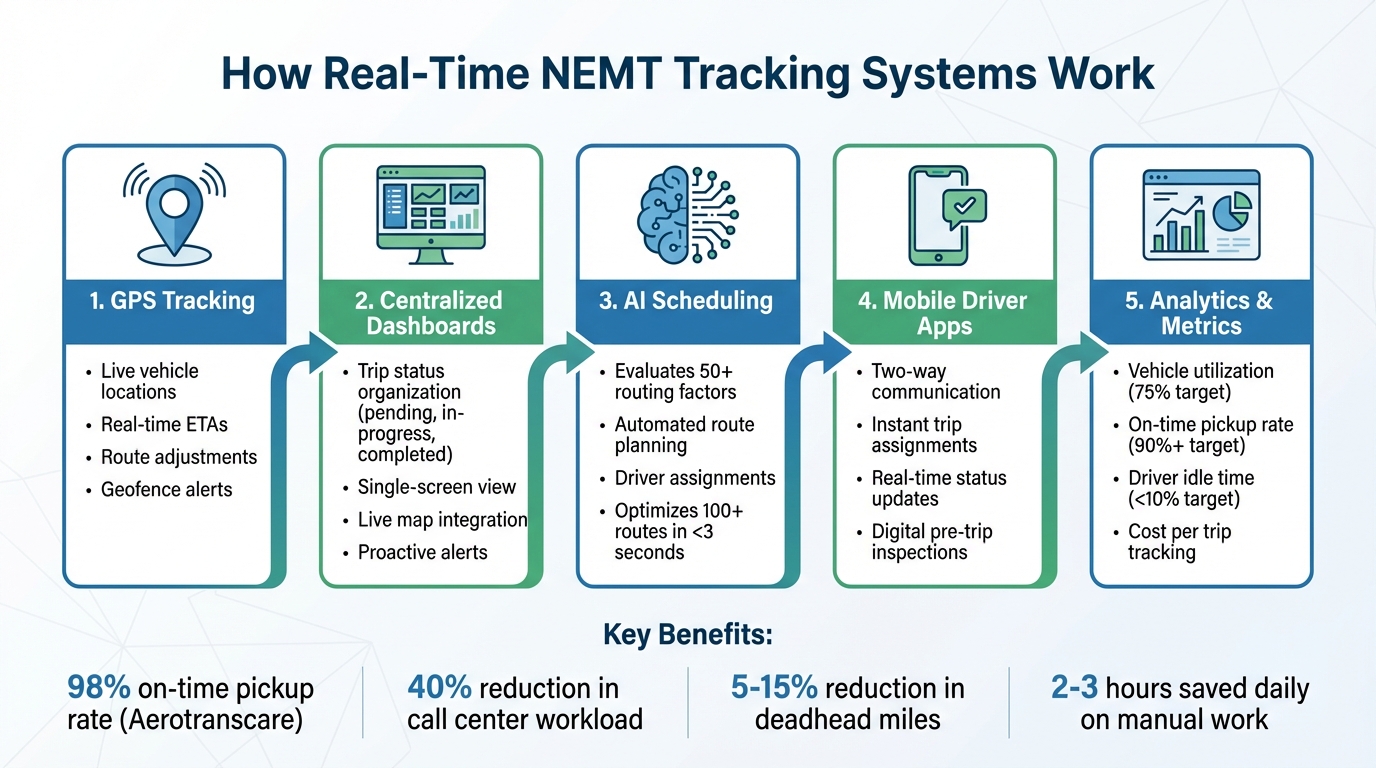
How Real-Time NEMT Tracking Systems Work: 5 Core Components
GPS tracking combines mobile driver apps with cloud-based dashboards to deliver a real-time map view of your entire fleet. Dispatchers can instantly see each vehicle's location, speed, and route without relying on manual updates or constant radio communication. This streamlined approach reshapes how daily dispatch operations are managed. Let’s break down how GPS boosts trip visibility and fleet efficiency.
GPS tracking goes beyond just pinpointing locations. Dispatchers can monitor trip statuses like "on-route" or "arrived", while advanced mapping tools calculate precise ETAs using live traffic data and historical patterns. If a driver veers off the planned route, the system sends immediate alerts, allowing dispatchers to respond before a minor detour turns into a significant delay.
Geofence alerts further simplify operations by automatically notifying dispatchers when vehicles enter or exit specific zones, such as hospital pickup areas. This eliminates the need for drivers to manually check in, letting dispatchers focus on trips that require attention. For instance, between 2024 and 2025, Aerotranscare in Virginia leveraged these tools to manage over 3,000 trips monthly, achieving a 98% on-time pickup rate while cutting call center workload by 40%. Beyond tracking, GPS plays a key role in improving overall operational efficiency.
GPS-powered route optimization takes into account real-time traffic, accidents, and road closures to suggest instant detours, ensuring trips stay on schedule. This dynamic rerouting can reduce unoccupied driving, or "deadhead miles", by 5–15%, which directly lowers fuel expenses and vehicle wear. Some systems can even optimize over 100 routes in less than 3 seconds.
Geolocation-based driver assignment adds another layer of efficiency by automatically matching the closest available driver to urgent trip requests, saving dispatchers 2–3 hours of manual work each day. Additionally, GPS telematics track driver behavior, flagging risky actions like harsh braking or speeding. This not only enhances safety but can also lead to reduced insurance costs.
While GPS tracking tells you where vehicles are, a centralized dispatch dashboard takes it a step further by offering a complete picture of every trip in real time. Instead of juggling spreadsheets, phone calls, and multiple browser tabs, dispatchers can monitor live trips on a single screen, with updates flowing in as drivers check in through their mobile apps.
The dashboard organizes trips into queues based on their current status, reflecting the natural flow of a ride. For example, trips awaiting driver assignment fall under "pending", while those with a confirmed driver move to "scheduled." Active rides are tagged as "in-progress", and completed trips are ready for billing. This structure allows dispatchers to focus on trips that need immediate attention, rather than getting bogged down tracking every completed ride. By grouping rides by status, the dashboard ensures a clear and structured workflow.
Take Green Med Trans Inc., for instance. They used this system to scale their operations to 5,000 trips per month, all while maintaining a 99.2% claim approval rate and automating 88% of their dispatching.
Status categories act like a smart filing system, updating automatically as trips progress. For instance, when a driver marks "arrived at pickup" in their app, the trip seamlessly moves from "assigned" to "in-progress" on the dashboard. During busy hours, dispatchers can filter the view to focus only on unassigned trips, while live status counts at the top of the screen give a quick snapshot of overall operations.
This level of visibility made a huge difference for Helping Hands Transportation. They achieved a 95% on-time arrival rate and cut down manual paperwork by 80%.
When a facility calls about a delayed pickup, dispatchers no longer have to dig through multiple systems to find answers. The dashboard’s live map shows exactly where the assigned vehicle is, its updated ETA based on current traffic, and any flagged issues. If a driver is delayed by traffic, the dispatcher can reassign the trip with just one click.
"One live dashboard replaces spreadsheets and phone calls, letting dispatchers spot issues faster and keep service on schedule." - SHARE Mobility
Proactive alerts further streamline operations by flagging issues like no-shows, late vehicles, or overlapping assignments. These alerts significantly reduce the workload of call centers, especially for high-volume operations.
Planning trips manually can get messy, especially when juggling multiple appointments, traffic delays, and vehicle availability. AI-powered scheduling tools simplify this process by evaluating over 50 routing factors at once. These include driver certifications, specialized vehicle needs like wheelchair lifts, patient medical requirements, and appointment timeframes. The system groups trips efficiently to cut down on "empty miles" - those wasted drives without passengers - and ensures vehicles are utilized to their fullest potential.
For example, if a patient schedules a multi-stop trip - like traveling from home to a clinic, then to a pharmacy, and back - the AI takes into account appointment times and necessary waiting periods at each stop. If a cancellation or no-show occurs, the system immediately adjusts the remaining routes, filling gaps and minimizing wasted mileage. This kind of instant re-optimization is a game-changer, especially during busy hours, and far exceeds what human dispatchers can handle on the fly.
"The introduction of AI has revolutionized this process by transforming the dispatcher's role from a reactive problem-solver into a strategic manager." - NEMT Platform
Take Preventive Care as an example: they reduced their scheduling time by 40% after adopting an AI-powered routing solution. This tool automated the pairing of patients with healthcare professionals based on specific skills and vehicle requirements. It created efficient, ready-to-go routes without constant manual tweaking, paving the way for more advanced scheduling methods.
The technology behind these systems is impressive. AI optimization engines pull in live traffic updates, historical delay trends, and current vehicle locations to craft the best possible routes. For instance, if a particular route tends to run late every Tuesday, the system automatically adjusts the travel time to account for it, reducing the risk of missed appointments. It also clusters trips for facilities like nursing homes or dialysis centers, grouping patients into shared rides to cut costs and improve punctuality.
The system can manage shared rides for 2–6 passengers, balancing factors like time windows, medical needs, and vehicle capacity. For unpredictable scenarios - like hospital discharges - a "will-call" feature ensures a vehicle is dispatched only when the patient is ready, avoiding unnecessary driver wait times and keeping schedules on track.
AI doesn’t stop at scheduling - it also simplifies trip assignments. With one-click functionality, dispatchers no longer need to cross-check schedules or vehicle specifications manually. The software automatically assigns the nearest qualified driver using real-time GPS, current workload, and vehicle type.
"The app's automated dispatching and billing features have helped us save time and reduce errors, while the real-time tracking and communication features have helped us provide better service to our clients." - Rachel Green, Careful Transportation
Many platforms also integrate seamlessly with brokers like Modivcare and MTM. Ride requests flow directly into the dashboard, eliminating manual data entry. This streamlined process reduces typos, missed appointments, and billing disputes, allowing dispatchers to focus on handling exceptions rather than routine tasks.
Gone are the days of relying on phone calls, radios, and paper logs to coordinate trips. Mobile apps now make it possible for dispatchers to send trip assignments and updates directly to drivers' smartphones in seconds. This eliminates the delays and confusion that used to plague manual communication methods. Drivers can confirm receipt instantly, creating a smooth and efficient workflow.
This upgrade matters because manual coordination often leads to miscommunication. A missed radio call or a misunderstood verbal instruction could result in missed pickups, eroding patient trust. Digital messaging ensures that all instructions are clear and easily accessible. If a patient’s appointment time changes or a facility needs to update pickup details, dispatchers can send the new information directly through the app. Drivers can acknowledge these updates with just one tap.
These apps also enable two-way communication, allowing drivers to report issues like trouble finding a patient or traffic delays. Instead of clogging communication channels, they use messaging or integrated calls to resolve problems on the spot. This real-time exchange keeps everyone informed and allows for quick adjustments to trips without disrupting operations.
Direct communication is just the start - driver feedback takes trip reliability to the next level. Real-time updates from drivers transform how trips are managed. Dispatchers can see live status updates on their dashboards, eliminating the need for constant radio check-ins and providing a clear view of every trip’s progress.
"Real-time dispatch reduces missed trips and confusion, making sure that passengers get where they need to go on time." - NEMT Platform
For example, if a driver flags a mechanical issue during a digital pre-trip inspection, the app immediately alerts the maintenance team. This proactive approach prevents breakdowns mid-route, avoiding situations where patients are left stranded or appointments are canceled at the last minute. Facilities benefit from knowing exactly when their patients will arrive, while patients experience shorter wait times and fewer “where is my ride?” calls to the dispatch center.
These app features, combined with centralized dashboards and AI-driven tools, create a system that’s responsive and efficient, ensuring trips run smoothly from start to finish.
Once scheduling and real-time updates are in place, integrating trip tracking with fleet and crew management takes operational efficiency to the next level. By linking fleet maintenance schedules and crew management directly to the dispatch board, this system builds on the benefits of real-time tracking.
Nothing derails a dispatcher’s day faster than assigning a trip to a vehicle that’s out of commission or a driver who’s unavailable. With integrated systems, vehicles needing maintenance - like an oil change or those flagged during a digital pre-trip inspection - are automatically marked as unavailable, ensuring they’re removed from the scheduling pool.
Driver qualifications are also monitored digitally. Alerts notify dispatchers 30 to 60 days before licenses, background checks, or certifications expire, ensuring only fully qualified drivers are assigned to trips. Real-time driver check-ins prevent ghost assignments, and if a vehicle breaks down mid-route, GPS tools quickly identify the nearest qualified replacement to keep disruptions to a minimum. By addressing these potential conflicts, dispatchers can focus on keeping operations running smoothly.
Beyond avoiding conflicts, integrated dashboards provide a comprehensive view of daily operations. A centralized system combines details like active trips, vehicle locations, driver assignments, and maintenance schedules into one screen. This "single pane of glass" approach eliminates the need to juggle multiple tools or make time-consuming calls to drivers for updates.
For example, Helping Hands Transportation used such tools to achieve 100% compliance, cut manual paperwork by 80%, and maintain a 95% on-time arrival rate.
"The system takes over the stuff that usually eats up time. Scheduling, routing, billing - all of it just runs smoother. Dispatchers don't have to double-check every ride." - NEMT Platform
This streamlined view helps dispatchers focus on exceptions rather than routine trips, leading to faster decisions and better coordination across the board.
Real-time tracking goes beyond simply pinpointing vehicle locations - it also generates performance data that sheds light on operational efficiency. By keeping an eye on the right metrics, dispatchers can quickly identify potential issues, make informed decisions, and improve overall service quality. This data becomes the backbone for monitoring critical performance indicators.
Four essential metrics offer a clear view of how well operations are running. Vehicle utilization rate measures the time or distance vehicles are actively in use versus idle, with a goal of hitting at least 75% during peak operating hours. On-time pickup rate tracks how often drivers meet their scheduled pickup times, with alerts typically set to trigger if performance drops below 90%. Driver idle time measures periods when drivers are available but not transporting passengers, with efficient operations aiming to keep this under 10% of total working hours. Finally, cost per trip combines expenses like fuel, wages, maintenance, and overhead; for instance, cutting the cost per trip from $45 to $38 can significantly improve monthly profits.
With real-time tracking, NEMT providers can use these metrics to uncover patterns in their operations and make data-driven changes. By continuously monitoring these indicators, dispatchers can address inefficiencies before they affect service quality.
Analytics dashboards take these metrics to the next level by transforming raw data into actionable insights. These tools allow dispatchers to filter data by driver, vehicle, or service type, making it easier to pinpoint recurring issues like consistently late routes or areas with insufficient vehicle coverage. Addressing these problems early prevents them from escalating further.
Metrics also pave the way for targeted improvements. For example, reducing driver idle time from 25% to 12% could boost the number of completed trips per driver by 15%. Similarly, increasing on-time pickup rates from 84% to 94% is a common goal for companies that adjust schedules based on automated alerts. Dispatchers can act immediately, reallocating idle vehicles to high-demand areas or building in buffer times at the start of shifts to handle early delays.
"The ability to see our business financials breakdown via brokers, corporate clients, dispatch jobs is simply awesome." - Evariste, Kinsemen Transport
Real-time tracking tools have transformed NEMT dispatch by integrating GPS for instant vehicle tracking, centralized dashboards for comprehensive trip oversight, and AI-driven scheduling that saves up to 2–3 hours of administrative work each day.
These advancements directly enhance service quality. Improved performance is further reinforced by seamless communication between drivers and dispatchers.
With mobile driver apps and automated notifications, real-time connectivity becomes effortless. Dispatchers can instantly relay updates to drivers, patients receive precise ETAs, and facilities stay informed about arrivals. This level of coordination minimizes no-shows and builds confidence among passengers who rely on dependable transportation.
Real-time data also equips dispatchers to monitor critical metrics like vehicle usage, on-time performance, and trip costs, enabling them to quickly address inefficiencies. Additionally, tracking driver behavior and route compliance adds a layer of accountability, boosting safety and lowering insurance expenses.
"NEMT Platform has simplified my dispatching process and allowed me to focus on growing my business." - Lisa M, Owner, Metro Medical Transport
As NEMT services expand, real-time tracking remains a cornerstone for maintaining high-quality operations.
Real-time GPS tracking plays a key role in helping NEMT dispatchers run operations more efficiently. With live updates on vehicle locations, dispatchers can make quick route adjustments, anticipate potential delays, and provide passengers with accurate ETAs. This ensures better coordination and a smoother experience for everyone involved.
Beyond route management, GPS tracking allows dispatchers to make smarter decisions about resource allocation. It helps cut down on idle time and keeps vehicles running on schedule. The result? More reliable transportation services for passengers who count on timely rides.
AI is transforming how NEMT (Non-Emergency Medical Transportation) trip scheduling works by automating critical tasks. For instance, it can assign trips to the best-suited drivers and adjust routes in real time. This not only cuts down on delays but also boosts punctuality and streamlines operations.
Another game-changer is AI's ability to offer predictive ETAs and quickly adapt to unexpected events, like traffic jams or last-minute cancellations. This keeps both dispatchers and drivers well-informed and operating efficiently. With these tools, NEMT providers can offer services that are more dependable and budget-friendly.
Centralized dashboards give NEMT dispatchers a real-time, all-in-one view of their entire operation, streamlining the way trips are managed and making it easier to respond to changes on the fly. By bringing together key details like vehicle locations, trip statuses, driver updates, and rider information into a single interface, these tools empower dispatchers to make quick, well-informed decisions while minimizing service disruptions.
With features like live GPS tracking, instant alerts for delays or no-shows, and insights into rider needs and vehicle availability, dispatchers can fine-tune routes, improve punctuality, and maintain smooth communication with both drivers and patients. The result? Greater efficiency in operations and a better overall experience for customers.
