
Managing non-emergency medical transportation (NEMT) dispatching is complex. Dispatchers juggle route planning, driver assignments, patient needs, and compliance requirements - all while ensuring timely service. When done poorly, it leads to missed rides, higher costs, and unhappy patients. Here's how software can help:
- Route Planning: AI-powered tools optimize routes in real-time, reducing fuel costs and missed appointments.
- Communication: Mobile apps streamline updates between dispatchers, drivers, and patients, cutting miscommunication.
- Last-Minute Changes: Automated scheduling quickly adjusts for cancellations or new requests, minimizing disruptions.
- Compliance: Features like GPS tracking and automated billing ensure accurate documentation for Medicaid and insurance claims.
Common Challenges in NEMT Dispatching
Even with skilled teams, NEMT dispatching often faces obstacles that can disrupt operations and impact patient care. Here are some of the most frequent and costly challenges.
Inefficient Route Planning
Planning routes manually can be a major drain on time and resources. Using spreadsheets or paper manifests often leads to missed opportunities to group passengers or reduce "deadhead" miles - the empty miles a vehicle travels between trips. These inefficiencies not only waste fuel but also increase wear and tear on vehicles.
Static routes are another issue. They can quickly fall apart due to traffic delays or unexpected driver call-offs, leaving patients waiting and appointments missed. Automated optimization, however, has been shown to cut fuel costs by 20% and reduce missed appointments by 30%. Additionally, manual vs. automated NEMT scheduling comparisons show that data entry errors can result in mismatched schedules, leading to ride refusals and unnecessary disruptions.
Communication Breakdowns Between Dispatchers and Drivers
Many NEMT operations still depend on outdated communication methods like phone calls, radio, and text messages to connect dispatchers with drivers. These fragmented systems often result in missed updates, especially during busy periods.
"Manual coordination through phone calls or spreadsheets creates errors that ripple through the entire system: missed pickups, long wait times, and costly reroutes." - Mike Author, NEMT Platform
For example, when a ride is canceled, dispatchers must notify drivers before they reach the pickup location. If they can’t make contact, the vehicle wastes time and fuel on an unnecessary trip. Without real-time GPS tracking, dispatchers often resort to calling drivers for status updates, which increases the risk of miscommunication.
Here’s how common communication issues can affect operations:
Communication IssueOperational ImpactMisheard phone or radio instructionsLate arrivals or incorrect pickup locationsDelayed cancellation updatesWasted trips and higher fuel costsErrors in mobility requirementsDrivers unable to accommodate passengers at pickupManual will-call managementPatients waiting too long after appointments
Managing Last-Minute Schedule Changes
Even the most carefully planned schedules rarely stay intact throughout the day. Dispatchers constantly deal with driver call-offs, last-minute trip requests, and patient cancellations.
"Anyone who has actually run an NEMT operation knows the job is not really 'scheduling.' It's juggling." - Elite Med Financials
Will-call returns - common after hospital discharges when patients are ready to leave - are particularly challenging. These unscheduled trips force dispatchers to scramble to locate the nearest available vehicle with the right equipment while still managing other trips. In manual systems, one driver calling off can lead to an hour of frantic phone calls and reshuffling manifests. This chaos often results in late pickups, unhappy patients, and even denied claims when important documentation gets lost.
"Static morning schedules look optimized at 6:00 a.m. and chaotic by lunch. Live optimization keeps the manifest efficient throughout the day." - Elite Med Financials
These daily disruptions underline the need for advanced tools, like AI-powered systems, to make dispatching more efficient and less stressful.
How AI-Powered Dispatch Software Solves These Problems
AI-powered dispatch software tackles issues like wasted miles, miscommunication, and chaotic schedules head-on. By shifting from reactive problem-solving to proactive, data-driven management, this technology directly improves patient care and reduces costs. Here's how it addresses these challenges.
Route Optimization and Cost Reduction
AI doesn't just plan routes - it continuously adapts them. By analyzing real-time traffic, road closures, and driver locations, the software recalculates the most efficient routes throughout the day. This dynamic method far outperforms static planning, which often becomes outdated as conditions shift.
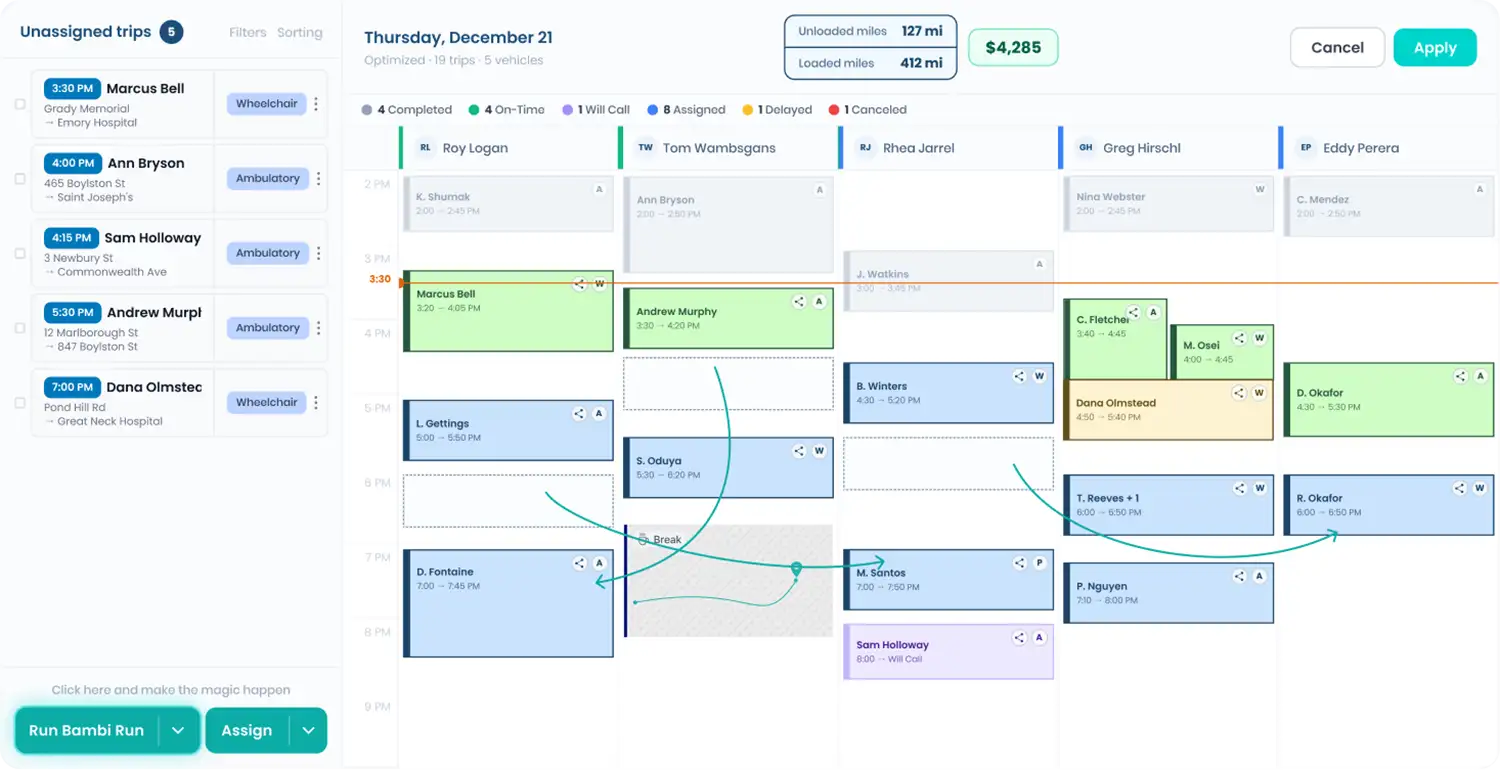
It also enables smarter multi-load coordination. For example, it can group compatible riders, such as pairing a wheelchair pickup with an ambulatory drop-off, into a single trip. This approach maximizes vehicle capacity and reduces the number of trips required. If a cancellation occurs, the system quickly reassigns nearby drivers to new trips, cutting down on wasted miles.
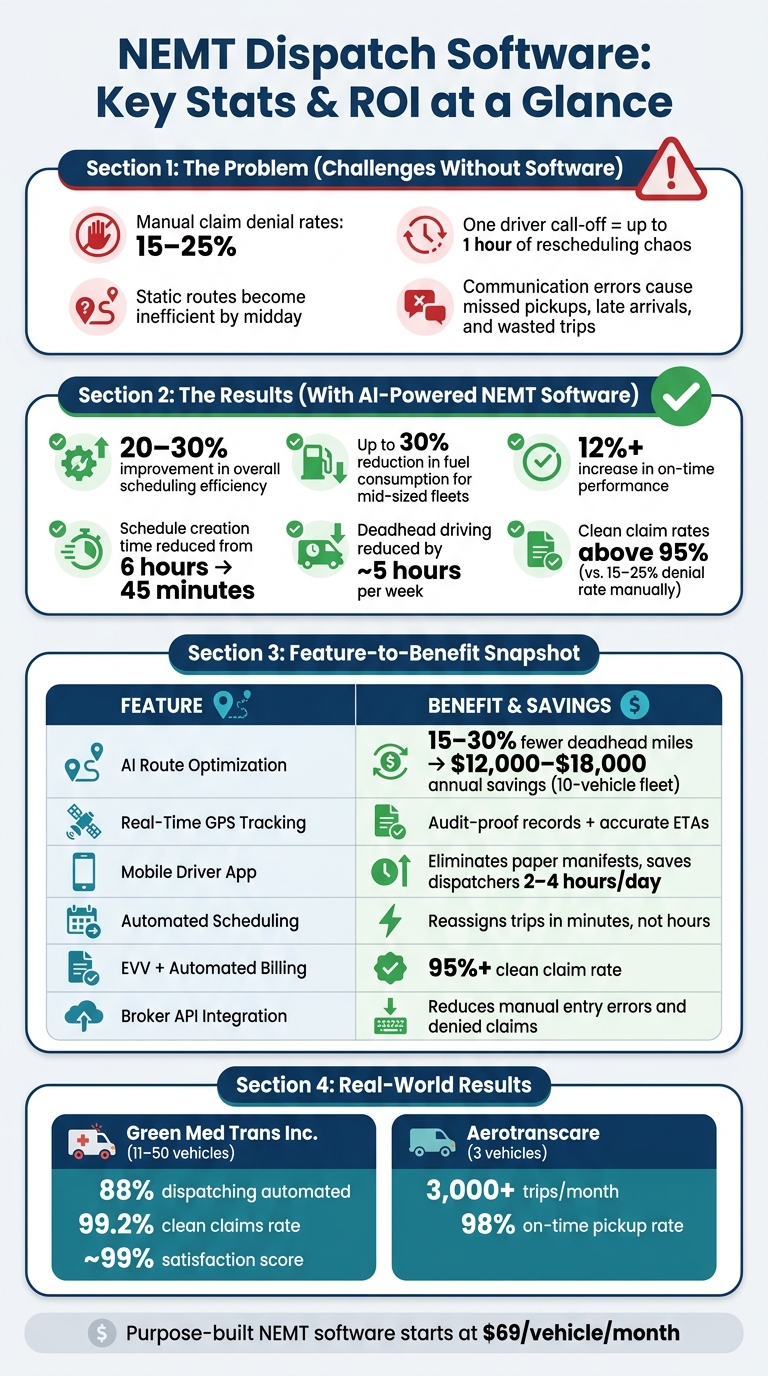
The results are impressive. Organizations using automated NEMT scheduling have seen efficiency improve by 20% to 30%, with AI-driven route optimization slashing fuel consumption by up to 30% for mid-sized fleets. On-time performance has also jumped by more than 12% following AI adoption. Beyond routing, the software enhances communication between dispatchers and drivers.
Real-Time Communication Tools
Gone are the days of endless phone calls and radio check-ins. With a dedicated mobile app, drivers receive instant updates on trip details, navigation, patient needs, and schedule changes. This ensures they have all the information they need without delays or confusion.
Dispatchers benefit from a live map that shows every vehicle's real-time location. Drivers' statuses - like "En Route", "At Pickup", or "Completed" - are automatically updated in the system, eliminating the constant "Where are you?" calls. Patients also stay in the loop with automated SMS alerts that provide estimated arrival times, helping reduce no-show rates by 25% to 30%.
"Driver Efficiency has increased tremendously since implementation as well as the dispatchers' ability to locate drivers." - Kristin P., SCR Medical Transportation
With communication streamlined, the software's ability to automate scheduling takes efficiency even further.
Automated Scheduling and Trip Assignments
When a driver calls out or a vehicle becomes unavailable, automated scheduling steps in to reassign trips within minutes. The system considers factors like vehicle type, driver certifications, and patient mobility needs to ensure the right match for every trip. This reduces the chances of service refusals and ensures smooth operations.
For recurring trips, such as dialysis or chemotherapy appointments, the software uses historical data to predict demand weeks in advance. These trips are automatically slotted into schedules before the day even begins. Even last-minute will-call requests are handled seamlessly, with the system quickly queuing returns and dispatching the nearest available vehicle.
Providers have reported significant time savings. Schedule creation times have dropped from 6 hours to just 45 minutes, and deadhead driving time has been reduced by an average of 5 hours per week.
Key Features to Look for in NEMT Dispatch Software
Purpose-built NEMT features are the backbone of software that helps providers avoid costly operational gaps while ensuring they get paid for their services.
Core Features That Improve Efficiency
An effective NEMT platform relies on AI-powered route optimization. By grouping compatible riders, it reduces deadhead miles by 15–30%, translating into annual savings of $12,000 to $18,000 for a 10-vehicle fleet.
Real-time GPS tracking offers precise, live updates on vehicle locations, ensuring accurate ETAs and audit-proof records. When paired with a mobile driver app and an automated scheduling engine, these tools eliminate paper manifests, provide instant trip updates, and save dispatchers 2–4 hours of work daily. Additionally, Broker API integrations with platforms like ModivCare, MTM, and Veyo enable seamless real-time trip data synchronization. Unlike outdated CSV uploads, these direct connections reduce manual entry errors, which are a common cause of denied claims.
By addressing challenges like inefficient routing and manual scheduling, these features streamline daily operations. However, operational efficiency is just one piece - compliance is equally critical.
"The real goal is not just to put rides on a calendar. The real goal is to move every scheduled trip through dispatch, driver documentation, trip verification, and billing without losing the data needed to get paid." - EliteMed Financials
Compliance and Documentation Tools
While smooth trip management is essential, meeting compliance standards is vital for guaranteed reimbursement. Electronic Visit Verification (EVV) captures timestamped GPS data at both pickup and drop-off points, creating the audit-proof records required by Medicaid and brokers.
Automated billing tools simplify processes by building claims from verified trip data, with the right HCPCS codes and origin/destination modifiers. Some payers also require EDI 837P claim files, so ask any vendor exactly which claim formats it produces. Bambi builds broker-ready invoices and tracks every payment; it does not create 837P or CMS-1500 claim files today. It’s also crucial to ensure the vendor signs a Business Associate Agreement (BAA) to meet HIPAA compliance requirements when handling patient health information.
"Medicaid doesn't pay for transportation. Medicaid pays for documented, verified, medically necessary transportation that meets specific compliance requirements." - EliteMed Financials
Finally, credential monitoring with automated alerts for expiring licenses, insurance, and certifications helps prevent operational disruptions and ensures uninterrupted service.
Conclusion: Using Software to Fix NEMT Dispatching Problems
Handling NEMT dispatching manually often leads to avoidable headaches. Poorly planned routes waste both fuel and time, miscommunication between dispatchers and drivers can result in missed pickups, and even one last-minute schedule change can throw an entire day into chaos. These problems don’t just disrupt operations - they also hurt your bottom line, compliance efforts, and, most importantly, the patients who rely on your service.
Dispatch software powered by AI directly addresses these challenges. Features like advanced route optimization cut down on unnecessary miles, while mobile apps for drivers replace unreliable phone calls with clear, trackable communication. Automated scheduling systems can process cancellations and reassignments in under five minutes - tasks that would otherwise take up to an hour. By streamlining the entire process, from scheduling to billing, providers can avoid the losses caused by manual mistakes and denied claims.
The results speak for themselves. Green Med Trans Inc., with a fleet of 11–50 vehicles, automated 88% of its dispatching and achieved a 99.2% clean claims rate, alongside satisfaction scores nearing 99%. Meanwhile, Aerotranscare, operating just three vehicles, managed over 3,000 trips per month with a 98% on-time pickup rate.
What’s more, the cost of this technology is reasonable. At $69 per active vehicle per month, purpose-built NEMT software is an investment that fits providers of all sizes. The real question isn’t whether it’s affordable - it’s whether you can afford to keep running without it.
FAQs
How hard is it to switch from manual dispatch to software?
Switching from manual dispatch to software might seem daunting at first, but modern NEMT software is designed to streamline this process. By automating tasks and enhancing communication, it helps reduce the challenges involved. The level of difficulty often depends on factors like the complexity of your workflow, the size of your operations, and how well your team is trained. While the initial steps may require effort - such as migrating data and conducting staff training - the payoff is significant. With proper planning and support, you can enjoy benefits like optimized routes, real-time updates, and fewer mistakes, making the transition well worth it.
What data do I need to start using AI route optimization?
Using AI for route optimization in Non-Emergency Medical Transportation (NEMT) requires a few essential data points. These include pickup and drop-off locations, scheduled times, and passenger details. To make the process even smoother, real-time updates like vehicle locations, traffic conditions, and driver availability play a critical role. By combining this information, the AI system can fine-tune routes, adjust to unexpected changes, and boost overall reliability in operations.
How does dispatch software help prevent denied Medicaid claims?
Dispatch software helps reduce denied Medicaid claims by automating billing processes, cutting down on errors, and ensuring precise documentation. It ensures compliance with Medicaid regulations, which plays a crucial role in avoiding claim rejections. By simplifying these processes, it boosts efficiency and increases the chances of successful claim approvals.
Run the numbers: the free NEMT operational cost estimator puts a yearly dollar figure on empty miles, no-shows, drivers waiting and retyping broker trips.