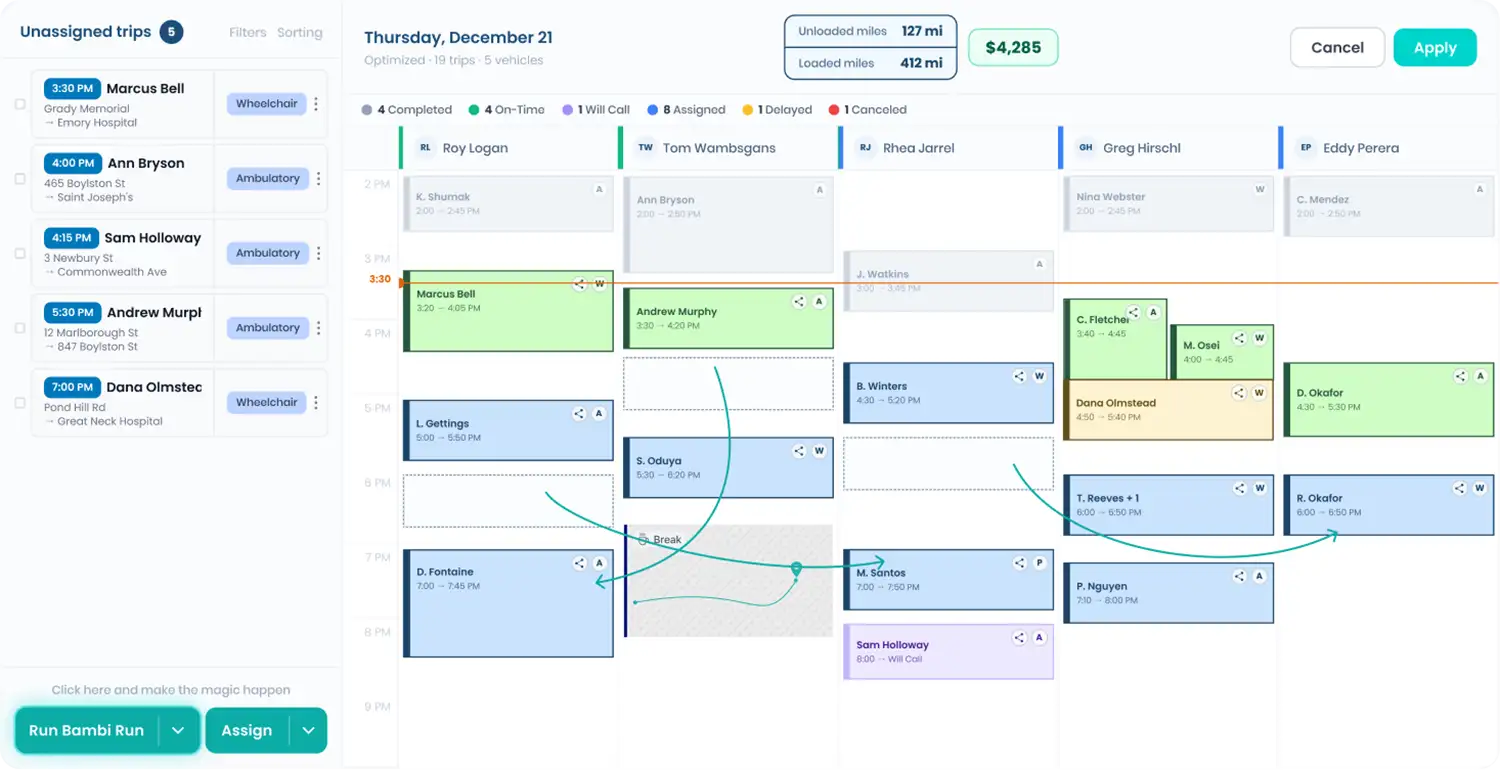

Managing driver schedules and availability can be a logistical headache for Non-Emergency Medical Transportation (NEMT) providers. Modern NEMT platforms simplify this process by automating key tasks, reducing manual errors, and improving efficiency. Here's how they help:
- Automated Scheduling: AI-powered systems assign trips based on driver location, certifications, and vehicle requirements, reducing no-shows and double bookings.
- Real-Time Adjustments: Platforms reallocate trips instantly during driver absences or delays, ensuring minimal disruptions.
- Route Optimization: AI creates efficient routes, saving time and cutting fuel costs by up to 25%.
- Driver Productivity: Multi-passenger ride-sharing and dynamic scheduling increase trips per driver without adding vehicles.
- Communication Tools: Mobile apps provide real-time updates, GPS tracking, and two-way messaging for seamless coordination.
- Billing and Compliance: Automated systems handle claims, reduce errors, and improve cash flow with faster reimbursements.
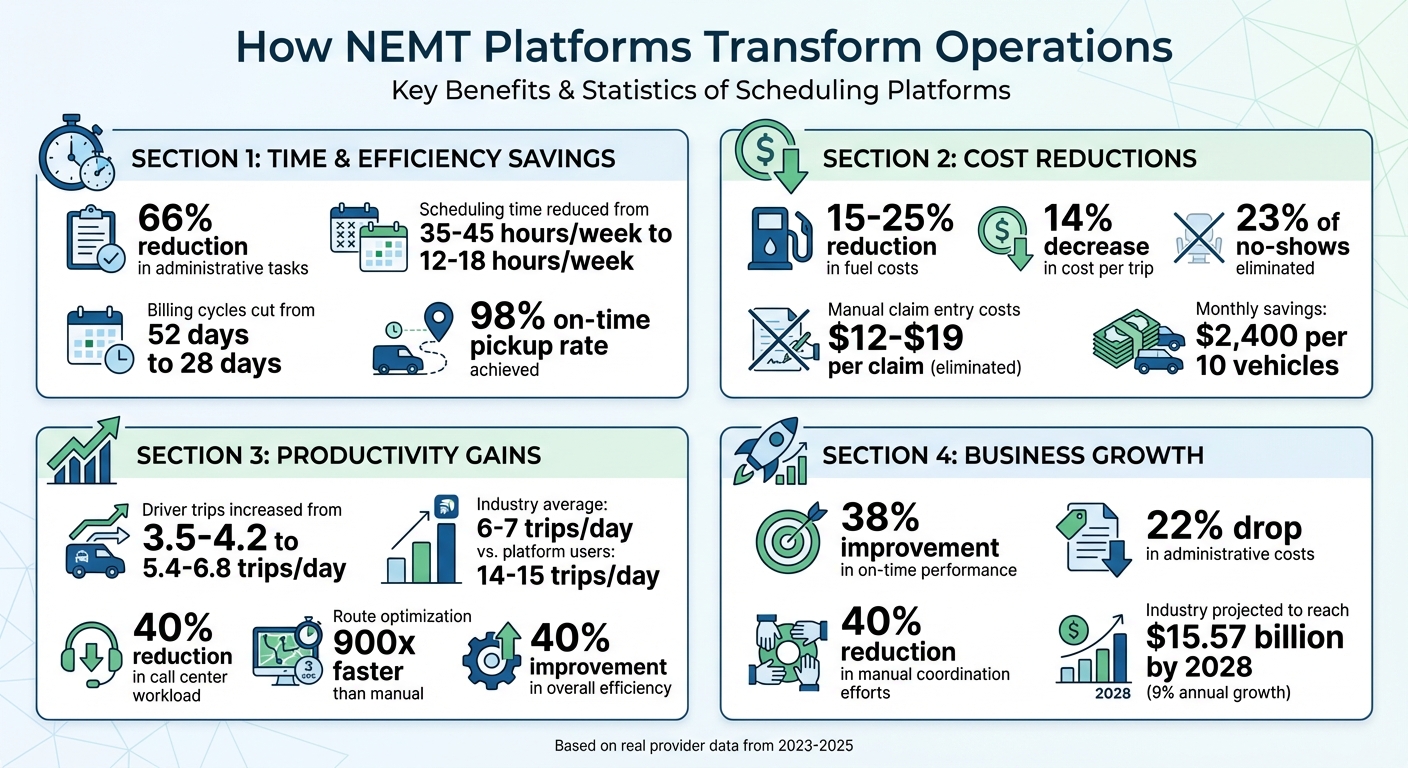
The result? Providers cut scheduling time by up to 66%, lower costs, and improve on-time performance - boosting both service quality and profitability.
Core Features for Managing Driver Availability
Modern NEMT (Non-Emergency Medical Transportation) platforms rely on automated systems to handle driver scheduling in real time. These systems match trips to drivers based on factors like proximity, certifications, vehicle type, and workload. Manual scheduling errors account for up to 23% of NEMT no-shows, but automation uses data to prevent issues like double-booking and mismatched assignments. By addressing the challenges of manual coordination, these platforms help reduce missed appointments and wasted resources. Here’s a closer look at how automation improves scheduling and driver efficiency.
Automated Trip Assignment Based on Driver Availability
AI-powered algorithms use live GPS and traffic data to assign trips to the nearest qualified driver. The system also checks driver certifications, such as CPR training or wheelchair assistance credentials, and ensures vehicles meet passenger requirements. When last-minute changes arise - like cancellations or new requests - the platform dynamically reassigns rides, keeping disruptions to a minimum.
For example, in July 2025, MetroCarre Medical Transport adopted AI-driven dispatch under Operations Manager Sarah J. The company reported a 38% improvement in on-time performance and a 22% drop in administrative costs related to billing and scheduling. Sarah J. shared:
Before NEMT Platform, our dispatchers were utterly overwhelmed... Since implementing NEMT Platform's comprehensive NEMT Management Software, our operational landscape has completely transformed.
This automated precision not only cuts costs but also boosts service reliability.
Managing Driver Absences and Schedule Changes
When a driver calls in sick or is delayed, the platform instantly reallocates trips to other available drivers. Mobile dispatch tools let dispatchers create trip requests, update vehicle details, and manage driver accounts right from their smartphones. Centralized HR systems track staff attendance and certifications, ensuring compliance. If no internal drivers are available, some platforms connect to third-party providers who can fill the gap. These automated systems reduce manual coordination efforts by up to 40%, allowing dispatchers to focus on more complex tasks. This ensures service continuity while keeping labor costs under control.
Real-Time Schedule Access for Dispatchers and Drivers
Cloud-based dashboards give dispatchers a full view of the fleet, including active rides and real-time alerts, all on one screen. Drivers receive updates like route changes and trip details instantly through mobile apps, eliminating the need for phone calls or paper logs. Status-tagged queues - such as "Assigned", "In Progress", or "Completed" - help both dispatchers and drivers monitor every trip’s progress. Automated notifications via SMS, email, or in-app messages, combined with GPS tracking, provide live location updates and adjust ETAs on the fly for both dispatchers and drivers.
Providers using these tools have achieved on-time pickup rates as high as 98%, while drivers average 14-15 trips per day, nearly doubling the industry standard of 6-7 trips. This level of visibility improves not only service quality but also driver productivity.
AI-Powered Route Planning and Driver Productivity
Modern route planning tools, powered by AI, are transforming how Non-Emergency Medical Transportation (NEMT) services operate. These tools go beyond basic scheduling to boost driver efficiency and ensure dependable service.
AI algorithms can process over 50 different factors simultaneously. These include details like driver certifications, specialized vehicle equipment (such as wheelchair lifts or stretcher tie-downs), patient mobility needs, and appointment timeframes. By analyzing this data, the system creates highly efficient routes and continuously updates them in real time based on traffic conditions, vehicle issues, or last-minute changes. This dynamic approach not only saves time but also cuts fuel consumption.
Smart Route Planning to Save Time and Fuel Costs
Using machine learning, NEMT platforms streamline multi-stop journeys. For example, the system can automatically link trips - like traveling from home to a clinic, then to a pharmacy, and back home - while factoring in wait times and potential delays. This ensures drivers stay on schedule. Additionally, the AI identifies opportunities to group passengers from similar locations, such as nursing homes or dialysis centers, into shared rides. This reduces unnecessary miles and fuel usage.
The speed of these systems is impressive. AI can optimize over 100 routes in under three seconds, making it about 900 times faster than manual scheduling. The result? Operators often save around $2,400 monthly for every 10 vehicles in their fleet.
Increasing Trips Per Driver Without Adding Vehicles
AI doesn’t just optimize routes - it also boosts driver productivity. By leveraging predictive algorithms and distance matrix APIs, the system calculates precise ETAs for multiple stops, cutting down on idle time. It also manages unpredictable scenarios, like hospital discharges, by quickly reallocating available vehicles when a patient is ready, reducing unnecessary waiting.
Multi-passenger ride-sharing is another key feature. By grouping 2–6 riders with similar routes and timeframes into one vehicle, the system maximizes capacity without sacrificing care quality. This approach can save operators 2–3 hours of manual work daily and improve efficiency by up to 40%. With these tools, drivers can complete more trips without the need to expand the fleet, directly increasing revenue per vehicle.
Communication Tools and GPS Tracking
Clear and instant communication is the backbone of smooth coordination between dispatchers, drivers, and patients. Modern Non-Emergency Medical Transportation (NEMT) platforms have replaced outdated methods like radio calls and phone check-ins with integrated mobile apps. These apps deliver trip assignments, digital manifests, and patient-specific instructions directly to drivers' smartphones, minimizing miscommunication and documenting all interactions. This streamlined communication supports key functionalities that enhance efficiency across operations.
GPS Tracking for Trip Monitoring
Real-time GPS tracking gives dispatchers a live view of their fleet on a map. This visibility allows them to focus on "exceptions" - rides flagged for potential delays caused by traffic, vehicle issues, or route changes. When problems arise, GPS data enables dispatchers to quickly identify the nearest available driver and reassign trips to avoid leaving patients stranded. This centralized system also helps hold drivers accountable by reducing idle time and preventing unauthorized detours.
"NEMT Platform has simplified my dispatching process and allowed me to focus on growing my business." - Lisa M, Metro Medical Transport
By combining live tracking with documented communication, dispatchers and drivers can resolve issues efficiently and ensure seamless service.
Direct Communication Between Dispatchers and Drivers
Two-way messaging within the platform allows secure, documented updates between dispatchers and drivers, eliminating the need for phone calls. Drivers can update their trip statuses - "Arrived", "Patient Onboard", "Dropped Off" - with just a tap, and these updates are instantly visible on the dispatcher's dashboard. When schedules change, drivers receive updated instructions in real time. Many apps also include SOS buttons for emergencies like vehicle breakdowns or safety concerns. Providers using these tools have reported impressive results, such as a 98% on-time pickup rate and a 40% reduction in call center workload.
Real-Time Trip Information for Customers
Transparency is key to building trust. Patients, caregivers, and medical facilities can track vehicles in real time via GPS, eliminating the stress of waiting and wondering where their ride is. Automated notifications - sent via SMS, email, or push alerts - let patients know when their driver is nearby, which helps reduce no-shows. These updates also allow family members or facility coordinators to monitor trips without needing to call dispatchers for status updates.
This level of transparency benefits everyone: patients gain confidence in the service, facilities can better manage appointment schedules, and providers experience fewer inbound calls.
"Real-time trip tracking in NEMT is changing how patients travel to care. Live vehicle location, accurate ETAs, and status updates help ensure timely pickups, improve transparency, and cut down on missed appointments." - NEMT Platform
Business Benefits of NEMT Scheduling Platforms
Time Savings and Less Manual Work
Traditional scheduling methods can be incredibly time-consuming, with most providers dedicating 35–45 hours per week to manual scheduling tasks. With the introduction of AI-powered platforms, this workload drops significantly to just 12–18 hours per week. These platforms handle trip matching, route planning, and conflict resolution automatically, freeing up dispatchers to focus on handling exceptions and driving business growth.
For instance, between 2023 and 2025, Aerocare Transport in Ohio managed to cut their scheduling time from 35 to 12 hours per week by adopting an all-in-one NEMT platform. Similarly, Valley Rise Transportation in Pennsylvania reduced their scheduling time from 45 to 18 hours per week over a 24-month period.
"Before NEMT Platform, our dispatchers were utterly overwhelmed. We were constantly battling daily delays, managing frustrated drivers, and struggling immensely with efficient non-emergency transportation scheduling. The manual process was a bottleneck, leading to missed appointments and lost revenue." - Sarah J., Operations Manager, MetroCarre Medical Transport
These platforms also streamline billing processes. Manual data entry for a single medical claim can cost between $12 and $19. Automated systems that verify patient eligibility and generate claims can cut billing cycles from 52 days to 28 days, significantly improving cash flow.
The combination of these time savings and process efficiencies directly reduces operational costs, as outlined below.
Lower Costs Through Automation
Automation doesn’t just save time - it also helps reduce costs by improving resource allocation. For example, route optimization technology can lower fuel consumption by 15%–25%, minimizing deadhead miles and improving overall efficiency. Aerocare Transport successfully reduced their fuel expenses from 28% to 21% of total operating costs while expanding their fleet from 8 to 18 vehicles, achieving a 14% reduction in cost per trip. Likewise, Metro Services in Phoenix, Arizona reported a 15% decrease in cost per trip over three years by using advanced analytics and automated billing.
Driver productivity also improves significantly with automated systems. While manual operations typically result in 3.5–4.2 trips per driver per day, automated platforms increase this to 5.4–6.8 trips - without the need for additional vehicles. For example, Valley Rise Transportation boosted their driver utilization from 3.5 to 5.4 trips per day, leading to a 12% improvement in overall cost efficiency. This allows providers to serve more patients and generate higher revenue using their existing fleet.
AI-powered solutions also help mitigate costly errors. Automated reminders reduce no-shows, which contribute to the staggering $150 billion annual cost of missed medical appointments in the healthcare system. Additionally, proactive vehicle maintenance tracking helps prevent expensive emergency repairs, while real-time monitoring of driver behavior - such as hard braking or speeding - can lower insurance premiums by identifying and addressing risky habits.
Conclusion
Managing driver schedules and availability doesn't have to be a headache. Modern NEMT platforms tackle long-standing challenges like double-bookings, cancellations, inefficient routing, and endless paperwork. By automating trip assignments, optimizing routes in real-time, and improving communication between dispatchers, drivers, and patients, these tools turn operational chaos into a well-oiled machine.
The results speak for themselves. Take J&Tig Transportation in Virginia, for example - they expanded from a single vehicle to a 42-vehicle fleet generating $4.8 million in revenue, all while slashing administrative tasks by 66%. Similarly, Aerotranscare handles over 3,000 trips monthly, maintains a 98% on-time pickup rate, and cut their call center workload by 40%.
This kind of efficiency sets the stage for growth. With the NEMT industry projected to hit $15.57 billion by 2028, growing at nearly 9% annually, providers who embrace advanced scheduling technology position themselves as reliable partners for healthcare plans and state agencies. By delivering higher reliability and efficiency, they gain a clear competitive advantage.
As one user of these platforms put it:
"The system takes over the stuff that usually eats up time... You can actually focus on the people, not the process." - NEMT Platform
FAQs
What data does the platform use to match trips to drivers?
The NEMT platform leverages both real-time and historical data to streamline operations. It gathers details like driver availability, location, and status, along with trip specifics such as pick-up and drop-off points, appointment schedules, patient needs, and even traffic conditions. Using advanced AI-powered systems, this data is analyzed to match drivers with trips based on factors like proximity, vehicle capacity, and timing.
By optimizing routes and factoring in client-specific requirements, the platform helps cut down on wait times, ensures better punctuality, and boosts overall efficiency.
How does it handle last-minute driver callouts or delays?
Non-emergency medical transportation (NEMT) platforms tackle last-minute driver callouts or delays with real-time trip management and dynamic dispatching. These tools allow for quick changes to schedules, rerouting, and seamless communication with both drivers and clients. With features like live tracking, instant updates, and proactive alerts, these systems help reduce disruptions, keeping services running smoothly and on time, even when unexpected issues arise.
What do drivers need to use the mobile dispatch app?
Drivers benefit greatly from a mobile dispatch app that provides essential tools for managing trips, tracking locations in real-time through GPS, and updating passenger statuses such as pick-up and drop-off. These features simplify daily tasks and enhance the overall efficiency of services.