
By Nick Hoffmeyer, Head of Marketing at Bambi · September 28, 2026 · 9 min read
Reviewed by Howard F. Berkowitz, a non-emergency medical transportation and paratransit expert with 30+ years in the industry (H&S Consulting).
You can start a non-emergency medical transportation (NEMT) business with one van. Pick your niche and payer mix first, then register the business, get licensed, insure the vehicle, and equip it before you take a single ride. Land your first private-pay and broker contracts, then run scheduling on software built to scale, so van two isn't a system rebuild.
What's the Realistic Path to Starting an NEMT Business With One Van?
The realistic path is sequential, not simultaneous. Pick your niche and payer mix first, then register and license the business, insure the one vehicle you have, and only then start selling trips. Buying a van before you know who's riding in it is a common way single-van operators stall out early, sitting on a payment with no contracts to cover it.
A sensible order for a one-van operator: decide who you're serving, make it legal, insure it, equip it, sell it, then schedule it. Skip a step and you either burn cash waiting for approvals or take on trips you're not actually licensed or insured to run.
Step 1: Pick Your Niche and Payer Mix
Before you register anything, decide who your van serves. Ambulatory-only riders who can walk to the vehicle? Wheelchair riders? Dialysis and chemo regulars who ride three times a week (some of the most predictable revenue a single van can get)? Or private-pay seniors whose families book and pay directly, no broker in the middle?
One van means one schedule. A niche with predictable, recurring trips (dialysis, chemo, adult day programs) fills your calendar faster than one-off appointment rides, and it's easier to route efficiently with a single vehicle.
Step 2: Register the Business and Get Licensed
Register your business entity (most NEMT owner-operators form an LLC), get a federal EIN, and open a business bank account before any money changes hands. The U.S. Small Business Administration lays out the full sequence, and it applies to a one-van NEMT company the same as any other small business. Our NEMT startup checklist and full guide on how to start an NEMT business go deeper on each step.
Then handle transportation-specific licensing. Federally, FMCSA requires a USDOT number when you operate in interstate commerce with a vehicle that has a gross vehicle weight rating of 10,001 pounds or more or is designed or used to carry more than 8 passengers (including the driver) for compensation. A minivan running trips inside one state usually falls outside that rule, but FMCSA lists more than 35 states, including California, Florida, Missouri, New York, and Texas, that require some intrastate commercial carriers to get a USDOT number under their own rules, and whether that covers a minivan depends on your state's thresholds. On top of that, many states and counties have their own NEMT or medical transportation permits. Check with your state's motor carrier agency and your state Medicaid program before you take a paid trip.
If you plan to bill Medicaid, you'll also need to enroll as a Medicaid transportation provider in your state (or credential with the broker that manages NEMT there), and many states ask for an NPI number as part of that. Here's how to get an NPI number for your NEMT business. Enrollment steps and timelines vary by state, so get your state's checklist early.
Step 3: Insure the Van (and Yourself)
Insurance is a step operators often underbudget, and it's the one where cutting corners actually ends your business instead of just slowing it down. You'll typically need commercial auto liability coverage (higher limits than a personal policy), and depending on your state and payer contracts, possibly passenger accident/medical payments coverage, general liability, and workers' comp once you hire a first driver.
Required limits vary by state and by which brokers or payers you contract with, and broker minimums are often well above state minimums, so get the requirement in writing before you buy a policy. As a rough budgeting range, first-year premiums commonly run about $6,000 to $15,000 per vehicle, depending on your state, driving record, and coverage. For a full breakdown of coverage types and what they typically cost, see our guide to NEMT insurance.
Step 4: Choose and Equip the One Vehicle
Match the vehicle to the niche you picked in step 1, not the other way around. Ambulatory-only service can start with a well-maintained minivan or sedan. Wheelchair riders require a lift or ramp-equipped van, tie-downs, and a driver trained to secure a wheelchair correctly every single time. Our NEMT vehicle buyer's guide compares the common options, and our essential NEMT equipment list covers what goes inside.
Whether new or used, budget for a pre-purchase inspection, an ADA-compliant lift or ramp if needed, and a maintenance reserve. One van breaking down isn't a scheduling problem, it's a business-stopping problem, so build slack into your maintenance budget from day one.
Step 5: Land Your First Contracts
With one van, you're chasing two buckets of business at once: private pay (families and individuals who book and pay you directly, usually your fastest path to first revenue) and broker contracts (Modivcare, MTM, Alivi, and similar transportation brokers who assign Medicaid and health plan trips to credentialed providers).
Private pay gets you moving immediately: local senior communities, home health agencies, dialysis centers, and adult day programs are common referral sources for a new single-van operator. Broker credentialing takes longer (insurance, licensing, and vehicle inspection all get verified first) but it's usually the volume that lets you justify van two. Start the broker application while you're still building private-pay volume, not after. See our guide to getting medical transportation contracts.
Step 6: Schedule Like You Already Have a Fleet
With one van, you're the dispatcher, the scheduler, and probably the driver. A spreadsheet works for exactly as long as it takes to get your second recurring rider, then trip conflicts and back-to-back bookings start costing you real revenue.
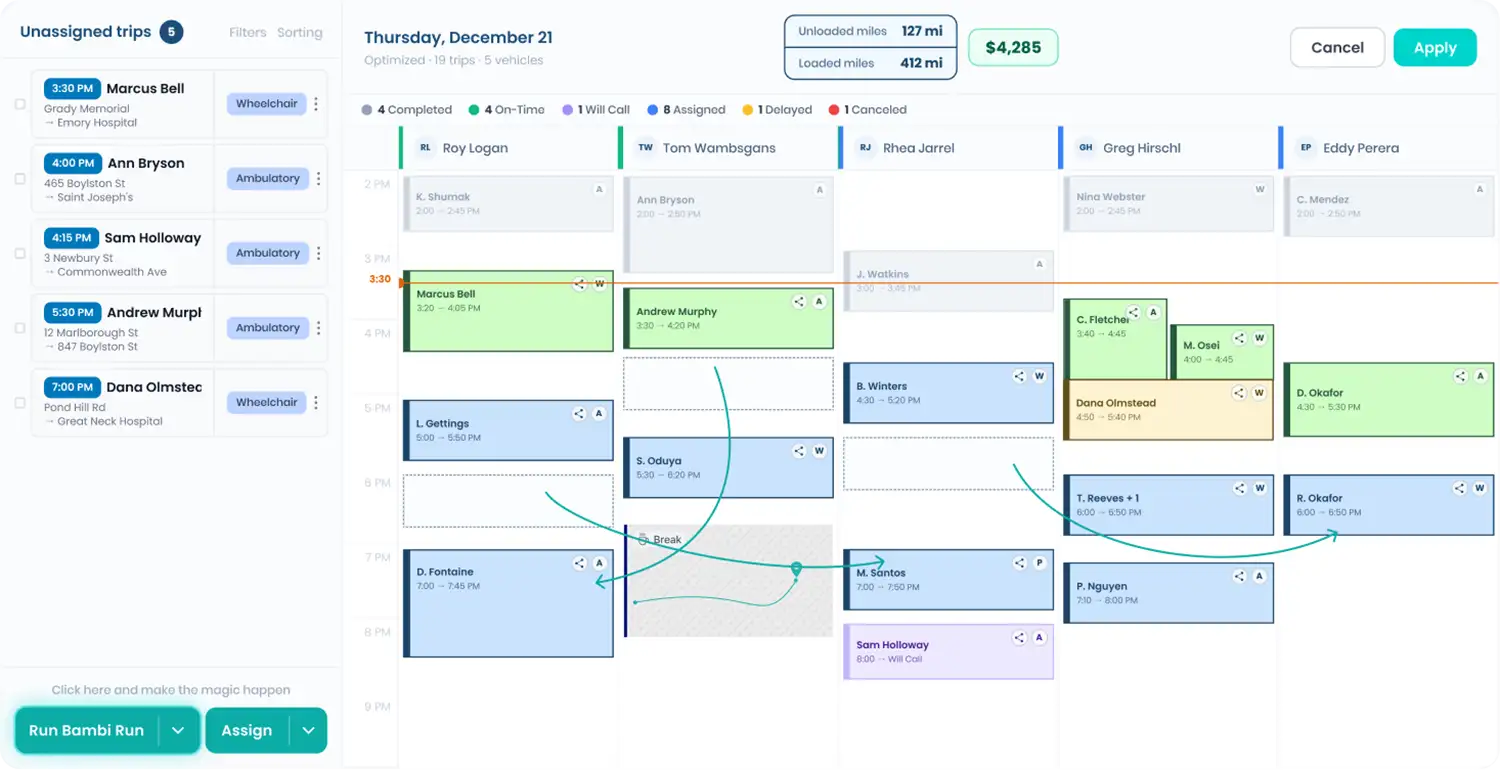
This is where Run Bambi Run earns its name: it assigns and schedules trips with one click using AI, the same way for one van or fifty, so you're not rebuilding your scheduling system the day you add vehicle two. Fleet HQ shows your vehicle on a live GPS map with real-time ETAs and driver status, and the Driver App puts the manifest, pickup and drop-off confirmation, and messaging with dispatch on the driver's phone. Riders get SMS notifications with a link to the Public Trip Portal to follow their trip.
Startup Checklist: The Order of Operations for One Van
- Choose your niche and payer mix (ambulatory, wheelchair, dialysis/chemo, private pay, or a mix)
- Form your business entity and get a federal EIN
- Open a business bank account
- Confirm state registration requirements (USDOT number, state motor carrier registration, local NEMT permits)
- Get an NPI and apply for Medicaid NEMT provider enrollment if you plan to bill Medicaid
- Secure commercial auto and required liability insurance at the limits your state and brokers require
- Buy or retrofit your one vehicle to match your niche
- Pass required vehicle inspections
- Screen and credential your first driver (background check, driving record, drug screen, plus any training your state or brokers require)
- Line up private-pay referral sources (senior communities, home health, dialysis centers)
- Submit broker credentialing applications in parallel
- Set up scheduling and dispatch software before your first recurring rider, not after
Startup Cost Checklist for a Single Van
- Business registration & EIN: What it covers: LLC filing, state fees; Typical range*: State LLC filing fees run up to about $500; the EIN is free from the IRS
- Commercial auto insurance (first year): What it covers: Liability, passenger coverage; Typical range*: Roughly $6,000 to $15,000 per vehicle
- Vehicle (used, ambulatory): What it covers: Reliable used minivan or sedan; Typical range*: Varies widely by year and mileage; get local quotes
- Vehicle (used, wheelchair-accessible): What it covers: Used converted van with ramp or lift; Typical range*: Roughly $25,000 to $45,000 (a new converted minivan can top $85,000)
- Driver background check & drug screen: What it covers: Per driver, one-time; Typical range*: Varies by state and screening vendor
- Scheduling/dispatch software: What it covers: Per vehicle, monthly; Typical range*: $69/vehicle/month (Bambi, flat, no contracts)
- Broker credentialing: What it covers: Application, inspection, and training requirements; Typical range*: Varies by broker; ask before you apply
- Maintenance reserve: What it covers: Set-aside for repairs; Typical range*: Set aside a fixed amount every month from day one
*Ranges are rough budgeting figures, not quotes, and change by state, vehicle condition, and broker. Get local quotes before you commit.
When Should a Single-Van NEMT Business Add a Second Vehicle?
Add vehicle two when your one van is turning down trips it could otherwise take, not before. The clearest signals are a waitlist of recurring riders you can't fit, broker trip offers you're declining because your schedule is full, or a driver (you) regularly working more hours than is sustainable. For a realistic sense of what one vehicle can actually bring in before you make that call, see how much NEMT companies make. As a rough benchmark, an ambulatory van blends about $25 to $30 per trip at 7 to 9 trips a day, and a wheelchair van about $35 to $45 per trip at 6 to 7 trips a day, with net margins of roughly 8 to 20%. Our revenue per vehicle deep dive breaks that down.
Financially, it pays to wait until the first van is consistently covering its own costs (insurance, fuel, maintenance, software) with room left over, so vehicle two isn't funded by hope. Because Bambi prices per vehicle with no contracts, adding van two costs exactly $69/month more, not a new subscription tier or a renegotiation.
FAQ
Do I need a USDOT number to start an NEMT business with one van? Not automatically. Federal USDOT registration generally applies when your vehicle meets certain size or passenger thresholds and operates in interstate commerce. A single van operating only within one state may not need it, but some states require intrastate registration regardless, so confirm with your state's transportation agency.
How much does it cost to start an NEMT business with one van? Costs vary widely by state, vehicle condition, and whether the van needs a wheelchair lift retrofit. Expect line items for business registration, commercial insurance (roughly $6,000 to $15,000 per vehicle in the first year), the vehicle itself (roughly $25,000 to $45,000 for a used wheelchair-accessible van, less for a used ambulatory minivan), driver screening, and scheduling software. See the cost table above.
Can I get broker contracts with just one vehicle? Generally, yes. Brokers like Modivcare, MTM, and Alivi credential small providers, though network needs vary by region and the process (insurance verification, licensing, vehicle inspection) takes time. Many one-van operators run private-pay trips while broker credentialing is in progress.
What insurance do I need for a single NEMT vehicle? At minimum, commercial auto liability coverage above personal auto limits, plus passenger coverage and general liability depending on your state and broker contracts. Minimum limits vary by state and broker, so confirm them before you buy.
Do I need a wheelchair-accessible van to start? No. Many single-van operators start ambulatory-only (riders who can walk to the vehicle) and add a wheelchair-accessible vehicle later, once demand and revenue justify the retrofit or purchase cost.
How do I get paid before I have broker contracts? Private pay: families, home health agencies, and senior communities that book and pay you directly. It's typically the fastest revenue source for a brand-new single-van operator while broker credentialing is still in process.
One van or fifty, Run Bambi Run schedules your entire board with one click, so you're not stuck juggling a spreadsheet while you drive. Bambi runs $69/month per vehicle, flat, no contracts, which means starting with one van costs exactly one van's worth. See pricing or book a demo to see it run your first schedule.
About the author: Nick Hoffmeyer is Head of Marketing at Bambi, the AI-powered dispatch and scheduling platform for non-emergency medical transportation (NEMT) providers. He leads Bambi's growth, SEO, and content strategy and works with NEMT owner-operators every day on the systems that help fleets run more trips with less stress. Connect with Nick on LinkedIn.